Looking for classes? Ksquare Career Institute, Bengaluru →

Moving Charges and Magnetism
Motion in Combined Electric and Magnetic Fields
13 questions from 11 papers, each with its answer.
- questions
- 13
- papers
- 11
- years asked, 2017–2026
- 3 of 10
- of Moving Charges and Magnetism
- 14.61%
Appears in
Concepts tested
- Lorentz force 2
- Radius in terms of kinetic energy 2
- Cyclotron period
- Magnetic force does no work
- Mass spectrometer
- Motion of a charge in parallel E and B fields
- Radius from perpendicular velocity
- radius of the circular path for equal momenta
- Velocity selector and circular motion
- Velocity selector and specific charge
- Velocity Selector Condition
All Questions
2025 1 question
-
An electron (mass $9 \times 10^{-31}\text{ kg}$ and charge $1.6 \times 10^{-19}\text{ C}$) moving with speed $c/100$ ($c =$ speed of light) is injected into a magnetic field $B$ of magnitude $9 \times 10^{-4}\text{ T}$ perpendicular to its direction of motion. We wish to apply a uniform electric field $\vec{E}$ together with the magnetic field so that the electron does not deflect from its path. Then (speed of light $c = 3 \times 10^8\text{ ms}^{-1}$):
For zero net force, $\vec{E}$ must be perpendicular to both $\vec{v}$ and $\vec{B}$, with magnitude $E = vB = (3 \times 10^6)(9 \times 10^{-4}) = 27 \times 10^2\text{ V/m}$.
For an undeflected charged particle (velocity selector principle), the Lorentz force must be zero: $q(\vec{E} + \vec{v} \times \vec{B}) = 0 \implies \vec{E} = -(\vec{v} \times \vec{B})$. Thus $\vec{E}$ must be perpendicular to $\vec{B}$ and $\vec{v}$. The velocity is $v = \frac{c}{100} = \frac{3 \times 10^8}{100} = 3 \times 10^6\text{ m/s}$. The required electric field magnitude is $E = vB = (3 \times 10^6\text{ m/s})(9 \times 10^{-4}\text{ T}) = 27 \times 10^2\text{ V m}^{-1}$.
2023 Manipur 1 question
-
A uniform electric field and a uniform magnetic field are acting along the same direction in a certain region. If an electron is projected in the region such that its velocity is pointed along the direction of fields, then the electron:Since the electron's velocity is along the direction of $\vec B$, the magnetic force ($q\vec v\times\vec B$) on it is zero. The electric force on the (negatively charged) electron, moving along the direction of $\vec E$, decelerates it, so its speed will decrease.
2019 1 question
-
Ionized hydrogen atoms and $\alpha$-particles with same momenta enters perpendicular to a constant magnetic field, $B$. The ratio of their radii of their paths $r_H:r_\alpha$ will be:Radius of the path in a magnetic field: $r=\frac{p}{qB}$ For the same momentum and field, $r\propto\frac{1}{q}$. $\frac{r_H}{r_\alpha}=\frac{q_\alpha}{q_H}=\frac{2e}{e}=\frac{2}{1}$ $r_H:r_\alpha=2:1$
2015 AIPMT-II 1 question
-
A proton and an alpha particle both enter a region of uniform magnetic field, B, moving at right angles to the field B. If the radius of circular orbits for both the particles is equal and the kinetic energy acquired by proton is 1 MeV, the energy acquired by the alpha particle will be:$R = \frac{mv}{qB} = \frac{\sqrt{2mK}}{qB}$
$R_\alpha = R_p$: $\frac{2(4m_p)K_\alpha}{(2e)^2B^2} = \frac{2m_pK_p}{e^2B^2}$
$K_\alpha = K_p = 1$ MeV
2012 AIPMT-MAINS 1 question
-
A proton carrying 1 MeV kinetic energy is moving in a circular path of radius R in uniform magnetic field. What should be the energy of an $\alpha$-particle to describe a circle of same radius in the same field?$R = \frac{mv}{qB} = \frac{\sqrt{2mE}}{qB}$
For equal radii: $\frac{\sqrt{2m_pE_p}}{q_pB} = \frac{\sqrt{2m_\alpha E_\alpha}}{q_\alpha B}$
$E_\alpha = \left(\frac{q_\alpha}{q_p}\right)^2\left(\frac{m_p}{m_\alpha}\right)E_p$, with $\frac{m_p}{m_\alpha} = \frac{1}{4}$ and $\frac{q_\alpha}{q_p} = 2$
$E_\alpha = (2)^2\times\frac{1}{4}\times E_p = E_p$
$E_\alpha = 1$ MeV
2011 AIPMT-PRE 1 question
-
A uniform electric field and a uniform magnetic field are acting along the same direction in a certain region. If an electron is projected in the region such that its velocity is pointed along the direction of fields, then the electronMagnetic force: $\vec{F}_m = q(\vec{v}\times\vec{B})$. The velocity is parallel to $\vec{B}$, so $\vec{v}\times\vec{B} = 0$ and there is no magnetic force; the electron does not turn.
Electric force: $\vec{F}_e = q\vec{E} = -e\vec{E}$. Since the electron has negative charge, this force is opposite to $\vec{E}$.
The velocity is along $\vec{E}$, so the electric force is opposite to the velocity.
The electron is therefore retarded along its line of motion.
Hence its speed will decrease.
2010 AIPMT-MAINS 1 question
-
A particle having a mass of $10^{-2}$ kg carries a charge of $5\times10^{-8}$ C. The particle is given an initial horizontal velocity of $10^5\ m\,s^{-1}$ in the presence of electric field $\vec{E}$ and magnetic field $\vec{B}$. To keep the particle moving in a horizontal direction, it is necessary that
(a) $\vec{B}$ should be perpendicular to the direction of velocity and $\vec{E}$ should be along the direction of velocity
(b) Both $\vec{B}$ and $\vec{E}$ should be along the direction of velocity
(c) Both $\vec{B}$ and $\vec{E}$ are mutually perpendicular and perpendicular to the direction of velocity
(d) $\vec{B}$ should be along the direction of velocity and $\vec{E}$ should be perpendicular to the direction of velocity
Which one of the following pairs of statements is possible?Force on the particle: $\vec{F} = q\vec{E} + q(\vec{v}\times\vec{B})$. The particle keeps its direction if there is no net force perpendicular to its velocity.
(b): if $\vec{B}$ is along $\vec{v}$, the magnetic force $q(\vec{v}\times\vec{B})$ is zero; with $\vec{E}$ also along $\vec{v}$ the electric force only changes the speed, not the direction. So (b) is possible.
(c): if $\vec{E}$, $\vec{B}$ and $\vec{v}$ are mutually perpendicular, the electric force $q\vec{E}$ and the magnetic force $q(\vec{v}\times\vec{B})$ act along the same line and can be made equal and opposite ($v = \frac{E}{B}$, the velocity selector), so the particle goes undeflected. So (c) is possible.
(a): with $\vec{B}$ perpendicular to $\vec{v}$ there is an unbalanced magnetic force perpendicular to the velocity (the electric force along $\vec{v}$ cannot cancel it), so the path bends.
(d): with $\vec{E}$ perpendicular to $\vec{v}$ and no magnetic force, the electric force deflects the particle.
Hence the possible pair is (b) and (c).
2010 AIPMT-PRE 1 question
-
A beam of cathode rays is subjected to crossed electric (E) and magnetic (B) fields. The fields are adjusted such that the beam is not deflected. The specific charge of the cathode rays is given by (where V is the potential difference between cathode and anode)The beam is undeflected when the electric and magnetic forces balance: $eE = evB$, so $v = \frac{E}{B}$
The electrons gain their speed from the accelerating potential V: $eV = \frac{1}{2}mv^2$
$\frac{e}{m} = \frac{v^2}{2V}$
Substituting $v = \frac{E}{B}$: $\frac{e}{m} = \frac{E^2}{2VB^2}$
2008 AIPMT 1 question
-
A particle of mass $m$, charge $Q$ and kinetic energy $T$ enters a transverse uniform magnetic field of induction $\vec{B}$. After 3 seconds the kinetic energy of the particle will be -The magnetic force on a moving charge is $\vec{F} = Q(\vec{v} \times \vec{B})$.
This force is always perpendicular to both the velocity $\vec{v}$ and the magnetic field $\vec{B}$.
Power delivered by the force: $P = \vec{F}\cdot\vec{v} = 0$, because $\vec{F} \perp \vec{v}$.
Equivalently, the work done in a small displacement is $dW = \vec{F}\cdot d\vec{r} = 0$, because $\vec{F} \perp d\vec{r}$.
A force that does no work cannot change the kinetic energy or the speed of the particle; it only changes the direction of motion (the particle moves on a circular path).
Hence after 3 seconds (or after any time) the kinetic energy is still $T$.
2007 AIPMT-PRE 3 questions
-
A beam of electron passes undeflected through mutually perpendicular electric and magnetic fields. If the electric field is switched off, and the same magnetic field is maintained, the electrons moveThe beam passes undeflected, so the electric force balances the magnetic force: $eE = evB$.
This is possible only when the velocity of the electrons is perpendicular to both the electric and the magnetic field (velocity selector), with $v = \dfrac{E}{B}$.
When the electric field is switched off, only the magnetic force $F = evB$ acts on the electrons.
This force is always perpendicular to the velocity, so it does no work and the speed stays constant; it only changes the direction of motion.
A force of constant magnitude that is always perpendicular to the velocity acts as a centripetal force: $evB = \dfrac{mv^2}{r}$, giving $r = \dfrac{mv}{eB}$.
Since the electrons travel in a magnetic field perpendicular to their velocity, they move in a circular orbit. -
In a mass spectrometer used for measuring the masses of ions, the ions are initially accelerated by an electric potential $V$ and then made to describe semicircular path of radius $R$ using a magnetic field $B$. If $V$ and $B$ are kept constant, the ratio $\left(\dfrac{\text{charge on the ion}}{\text{mass of the ion}}\right)$ will be proportional toIn a mass spectrometer, when the ions are accelerated through a potential $V$: $\dfrac{1}{2}mv^2 = qV$ ...(i)
The magnetic field curves the path of the ions into a semicircular orbit, the magnetic force providing the centripetal force:
$Bqv = \dfrac{mv^2}{R} \Rightarrow v = \dfrac{BqR}{m}$ ...(ii)
Substituting (ii) in (i): $\dfrac{1}{2}m\left(\dfrac{BqR}{m}\right)^2 = qV$
$\dfrac{B^2 q^2 R^2}{2m} = qV$
$\dfrac{q}{m} = \dfrac{2V}{B^2 R^2}$
Since $V$ and $B$ are constants, $\dfrac{q}{m} \propto \dfrac{1}{R^2}$ -
Under the influence of a uniform magnetic field a charged particle is moving in a circle of radius $R$ with constant speed $v$. The time period of the motion
The magnetic force provides the centripetal force: $qvB = \dfrac{mv^2}{R}$
$\Rightarrow R = \dfrac{mv}{qB}$
Time period: $T = \dfrac{2\pi R}{v} = \dfrac{2\pi}{v} \times \dfrac{mv}{qB}$
$T = \dfrac{2\pi m}{qB}$
The speed $v$ cancels out: a faster particle moves in a proportionally bigger circle, so the time for one revolution is the same.
The time period depends only on the mass, the charge and the magnetic field, so it is independent of both $R$ and $v$.
2000 AIPMT 1 question
-
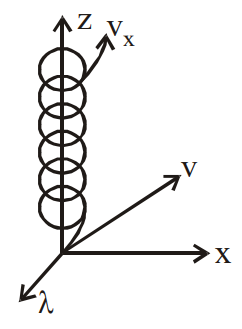
A charge having $\dfrac{q}{m}$ equal to $10^8$ C/kg and with velocity $3 \times 10^5$ m/s enters into a uniform magnetic field B = 0.3 tesla at an angle $30^\circ$ with direction of field. Then radius of curvature will be :Only the velocity component perpendicular to the field causes circular motion: $v_\perp = v\sin 30^\circ$.
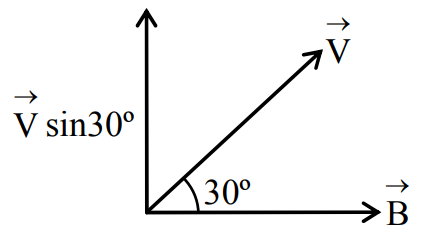
$r = \dfrac{mv_\perp}{qB} = \dfrac{m}{q} \cdot \dfrac{v\sin 30^\circ}{B}$
$r = \dfrac{3 \times 10^5 \times 0.5}{10^8 \times 0.3} = \dfrac{3 \times 10^5}{10^8 \times 0.3 \times 2}$
$r = 0.5 \times 10^{-2}$ m $= 0.5$ cm
(The particle moves along a helix of this radius.)