Looking for classes? Ksquare Career Institute, Bengaluru →

Moving Charges and Magnetism
Force on a Current-carrying Conductor in a Magnetic Field
7 questions from 7 papers, each with its answer.
- questions
- 7
- papers
- 7
- years asked, 2017–2026
- 2 of 10
- of Moving Charges and Magnetism
- 7.87%
Appears in
Concepts tested
- current-carrying-rod-incline
- F = I(L × B)
- Force on a closed loop
- Force on a current-carrying conductor in a magnetic field
- Net force on a closed current loop
- Net force on a closed loop
- square-loop-near-wire-force
All Questions
2023 1 question
-
A wire carrying a current $I$ along the positive $x$-axis has length $L$. It is kept in a magnetic field $\vec{B}=(2\hat{i}+3\hat{j}-4\hat{k})\ T$. The magnitude of the magnetic force acting on the wire is:
$\vec{F}=I(\vec{L}\times\vec{B})$ has magnitude $5IL$.
$|\vec{F}|=|I(\vec{L}\times\vec{B})|$ $=|I[L\hat{i}\times(2\hat{i}+3\hat{j}-4\hat{k})]|$ $=5\,IL$
2023 Manipur 1 question
-
A long straight wire of length 2 m and mass 250 g is suspended horizontally in a uniform horizontal magnetic field of 0.7 T. The amount of current flowing through the wire will be ($g=9.8\ ms^{-2}$):For the wire to be suspended (in equilibrium), the magnetic force balances gravity: $mg=i\ell B\Rightarrow250\times10^{-3}\times9.8=i\times2\times0.7\Rightarrow i=\dfrac{0.250\times9.8}{2\times0.7}=1.75$ A.
2018 1 question
-
A metallic rod of mass per unit length $0.5\ kg\ m^{-1}$ is lying horizontally on a smooth inclined plane which makes an angle of $30^\circ$ with the horizontal. The rod is not allowed to slide down by flowing a current through it when a magnetic field of induction 0.25 T is acting on it in the vertical direction. The current flowing in the rod to keep it stationary is
Balance $mg\sin\theta$ with the component $IlB\cos\theta$ of the horizontal magnetic force.
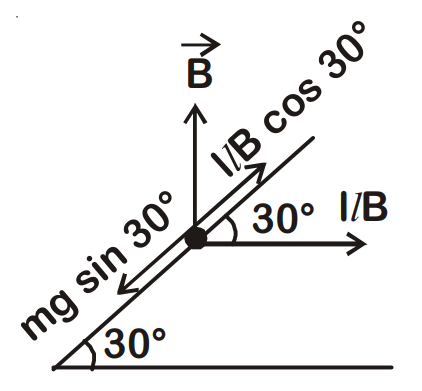
For equilibrium along the incline: $mg\sin30^\circ = IlB\cos30^\circ$
$I = \frac{mg}{lB}\tan30^\circ = \frac{0.5\times9.8}{0.25\times\sqrt{3}}$
$= 11.32$ A
2016 1 question
-
A square loop ABCD carrying a current i, is placed near and coplanar with a long straight conductor XY carrying a current I, the net force on the loop will be
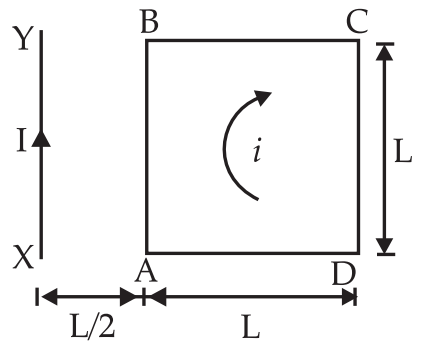
Forces on the two parallel sides are unequal because they are at different distances.
Sides BC and DA experience equal and opposite forces; only AB and CD contribute.
Field at AB (distance L/2): $B_{AB} = \frac{\mu_0I}{2\pi(L/2)} = \frac{\mu_0}{2\pi}\frac{2I}{L}$
Field at CD (distance 3L/2): $B_{CD} = \frac{\mu_0I}{2\pi(3L/2)} = \frac{\mu_0}{2\pi}\frac{2I}{3L}$
Net force $F = iLB_{AB} - iLB_{CD} = \frac{2\mu_0IiL}{2\pi L} - \frac{2\mu_0IiL}{6\pi L} = \frac{\mu_0Ii}{\pi} - \frac{\mu_0Ii}{3\pi}$
$F = \frac{2\mu_0Ii}{3\pi}$ (towards the wire)
2011 AIPMT-PRE 1 question
-
A current carrying closed loop in the form of a right angle isosceles triangle ABC is placed in a uniform magnetic field acting along AB. If the magnetic force on the arm BC is $\vec{F}$, the force on the arm AC is
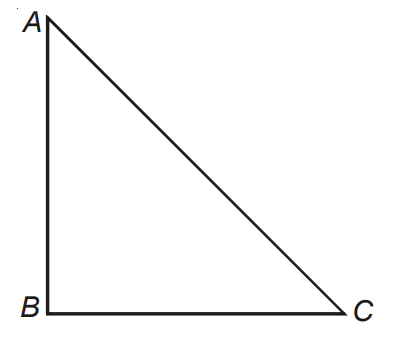 Force on a current-carrying straight conductor: $\vec{F} = I\vec{L}\times\vec{B}$
The net force on a closed current loop in a uniform magnetic field is zero: $\vec{F}_{AB} + \vec{F}_{BC} + \vec{F}_{CA} = 0$
The field is along AB, so for the arm AB the length vector is parallel to $\vec{B}$ and $\vec{F}_{AB} = 0$.
Therefore $\vec{F}_{BC} + \vec{F}_{CA} = 0$
$\vec{F}_{AC} = -\vec{F}_{BC} = -\vec{F}$
2010 AIPMT-PRE 1 question
-
A square current carrying loop is suspended in a uniform magnetic field acting in the plane of the loop. If the force on one arm of the loop is $\vec{F}$, the net force on the remaining three arms of the loop isThe net force on a closed current-carrying loop in a uniform magnetic field is zero: $\oint I\,d\vec{l}\times\vec{B} = I\left(\oint d\vec{l}\right)\times\vec{B} = 0$
Let $\vec{F}_1 = \vec{F}$ be the force on one arm and $\vec{F}_2$ the net force on the remaining three arms.
$\vec{F}_1 + \vec{F}_2 = 0$
$\vec{F}_2 = -\vec{F}_1 = -\vec{F}$
2008 AIPMT 1 question
-
A closed loop PQRS carrying a current is placed in a uniform magnetic field. If the magnetic forces on segments PS, SR and RQ are $F_1$, $F_2$ and $F_3$ respectively and are in the plane of the paper and along the directions shown, the force on the segment QP is :
($F_1$ acts towards the left on PS, $F_3$ acts towards the right on RQ and $F_2$ acts downward on SR.)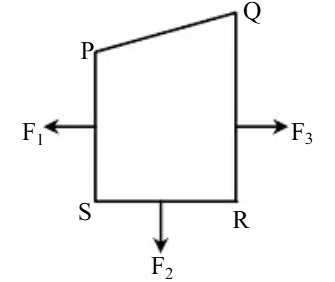 The total force on a current carrying closed loop placed in a uniform magnetic field is zero.
$\vec{F}_{PS} + \vec{F}_{SR} + \vec{F}_{RQ} + \vec{F}_{QP} = 0$
$F_1$ and $F_3$ are along the horizontal in opposite directions, so the horizontal resultant is $F_{horizontal} = (F_3 - F_1)$.
$F_2$ is along the vertical, so $F_{vertical} = F_2$.
The resultant of $\vec{F}_1$, $\vec{F}_2$ and $\vec{F}_3$ is $\vec{F}$, where $F = \sqrt{(F_3 - F_1)^2 + F_2^2}$ because the two components are perpendicular.
Since the total force is zero, the force on QP is equal to $\vec{F}$ in magnitude but opposite in direction.
$F_{QP} = \sqrt{(F_3 - F_1)^2 + F_2^2}$