Looking for classes? Ksquare Career Institute, Bengaluru →

Moving Charges and Magnetism
Magnetic Field due to a Circular Coil
15 questions from 14 papers, each with its answer.
- questions
- 15
- papers
- 14
- years asked, 2017–2026
- 4 of 10
- of Moving Charges and Magnetism
- 16.85%
Appears in
Concepts tested
- Current due to rotating charge 2
- Magnetic field due to circular arcs 2
- coil-n-turns-field
- Field of a circular current loop
- Field of a revolving charge
- Field of semicircular arcs
- Magnetic field at centre of current loop
- Magnetic field at the centre of a circular coil
- Magnetic field on the axis of a circular loop
- Orbiting charge as current
- Resultant of perpendicular fields
- Rewinding the same wire into more turns
All Questions
2026 1 question
-
A 100-turn closely wound circular coil of radius 5 cm has a magnetic field of $3.14 \times 10^{-3}$ T at its centre. The current flowing through the coil, and the magnitude of the magnetic moment of this coil are, respectively: (Take $\mu_0 = 4\pi \times 10^{-7}$ Tm/A)$B = \frac{\mu_0 N I}{2R} \Rightarrow I = \frac{2BR}{\mu_0 N}$ $I = \frac{2 \times 3.14 \times 10^{-3} \times 5 \times 10^{-2}}{4\pi \times 10^{-7} \times 100} = 2.5$ A Magnetic moment $M = NIA = 100 \times 2.5 \times \pi r^2$ $= 100 \times 2.5 \times 3.14 \times 25 \times 10^{-4} = 1.96 \approx 2\ A\,m^2$ So I = 2.5 A and M = 2 $A\,m^2$.
2026 Re-NEET 1 question
-
A current $I_0$ flows through a metallic circular loop of radius r as shown in the figure. Resistance of the segment ABC is half that of ADC. Magnitude of magnetic field at the centre O of the loop is:
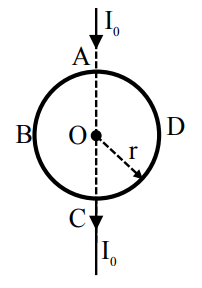 $R_1:R_2=1:2$ and $I\propto\frac{1}{R}$, so $I_1=\frac{2}{3}I_0$ (through ABC) and $I_2=\frac{1}{3}I_0$ (through ADC). The two semicircles give opposite fields at O: $B_{net}=\frac{\mu_0I_1}{4r}-\frac{\mu_0I_2}{4r}=\frac{\mu_0}{4r}\left(\frac{2I_0}{3}-\frac{I_0}{3}\right)=\frac{\mu_0I_0}{12r}$.
2024 1 question
-
A tightly wound 100 turns coil of radius 10 cm carries a current of 7 A. The magnitude of the magnetic field at the centre of the coil is (Take permeability of free space as $4\pi \times 10^{-7}$ SI units):$B = \frac{\mu_0 N I}{2R}$ $B = \frac{4\pi \times 10^{-7} \times 100 \times 7}{2 \times 10 \times 10^{-2}}$ $= \frac{28\pi \times 10^{-4}}{2} = 14\pi \times 10^{-4}$ T $\approx 44 \times 10^{-4}$ T $= 4.4$ mT
2022 Phase 2 2 questions
-
A closely packed coil having 1000 turns has an average radius of 62.8 cm. If the current carried by the wire of the coil is 1 A, the value of magnetic field produced at the centre of the coil will be (permeability of free space $=4\pi\times10^{-7}$ H/m) nearly:$B=\frac{\mu_0 NI}{2R}=\frac{4\pi\times10^{-7}\times1000\times1}{2\times62.8\times10^{-2}}=10^{-3}$ T.
-
The magnetic field on the axis of a circular loop of radius 100 cm carrying current $I=\sqrt{2}$ A, at point 1 m away from the centre of the loop is given by:$B=\frac{\mu_0 I R^2}{2(R^2+x^2)^{3/2}}=\frac{4\pi\times10^{-7}\times\sqrt{2}\times1^2}{2(1^2+1^2)^{3/2}}=\frac{4\pi\times10^{-7}\times\sqrt{2}}{2\times2\sqrt{2}}=\pi\times10^{-7}\approx3.14\times10^{-7}$ T.
2019 Odisha 1 question
-
A straight conductor carrying current i splits into two parts as shown in the figure. The radius of the circular loop is R. The total magnetic field at the centre P of the loop is:
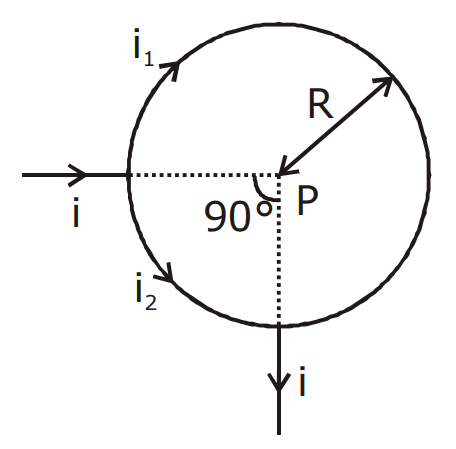 For an arc, $B=\frac{\mu_0 i\theta}{4\pi R}$. The two arcs (270° and 90°) are in parallel, so $\frac{i_1}{i_2}=\frac{R_2}{R_1}=\frac{l_2}{l_1}=\frac{\theta_2}{\theta_1}$, giving $i_1\theta_1=i_2\theta_2$. The fields are equal in magnitude and opposite in direction, so the net field at P is zero.
2016 Phase II 1 question
-
A long wire carrying a steady current is bent into a circular loop of one turn. The magnetic field at the centre of the loop is B. It is then bent into a circular coil of n turns. The magnetic field at the centre of this coil of n turns will be:
n turns and radius R/n give $n^2$ times the field.
Since $l = 2\pi R = n(2\pi r) \Rightarrow r = \frac{R}{n}$
For one turn: $B = \frac{\mu_0i}{2R}$
For n turns: $B' = \frac{\mu_0ni}{2r} = \frac{\mu_0n^2i}{2R} = n^2B$
2015 AIPMT-I 1 question
-
An electron moving in a circular orbit of radius r makes n rotations per second. The magnetic field produced at the centre has magnitude:Field at the centre of a circular current: $B = \frac{\mu_0 I}{2r}$
Equivalent current: $I = \frac{e}{T} = ne$
$B = \frac{\mu_0 ne}{2r}$
2012 AIPMT-PRE 1 question
-
Two similar coils of radius R are lying concentrically with their planes at right angles to each other. The currents flowing in them are I and 2I, respectively. The resultant magnetic field induction at the centre will beField at the centre of each coil: $B_1 = \frac{\mu_0I}{2R}$ and $B_2 = \frac{\mu_0(2I)}{2R}$
The planes are perpendicular, so the two fields are perpendicular to each other.
$B = \sqrt{B_1^2 + B_2^2} = \sqrt{\left(\frac{\mu_0I}{2R}\right)^2 + \left(\frac{2\mu_0I}{2R}\right)^2} = \frac{\sqrt5\mu_0I}{2R}$
2011 AIPMT-MAINS 1 question
-
Charge q is uniformly spread on a thin ring of radius R. The ring rotates about its axis with a uniform frequency f Hz. The magnitude of magnetic induction at the center of the ring isA rotating charged ring is equivalent to a circular current loop.
The charge q passes any point f times per second, so the current is $I = \frac{q}{T} = qf$
Magnetic field at the centre of a circular loop of radius R: $B = \frac{\mu_0I}{2R}$
$B = \frac{\mu_0qf}{2R}$
2010 AIPMT-MAINS 1 question
-
A current loop consists of two identical semicircular parts each of radius R, one lying in the x-y plane and the other in x-z plane. If the current in the loop is i, the resultant magnetic field due to the two semicircular parts at their common centre isMagnetic field at the centre of a full circular loop is $\frac{\mu_0i}{2R}$; a semicircle gives half of this: $B_1 = B_2 = \frac{\mu_0i}{4R}$
The field of each semicircle is perpendicular to its own plane. The semicircle in the x-y plane gives a field along the z-axis, and the one in the x-z plane gives a field along the y-axis.
The two fields are therefore perpendicular to each other and equal in magnitude.
Resultant: $B = \sqrt{B_1^2 + B_2^2} = \sqrt{2}\times\frac{\mu_0i}{4R}$
$B = \frac{\mu_0i}{2\sqrt{2}R}$
2010 AIPMT-PRE 1 question
-
A thin ring of radius R meter has charge q coulomb uniformly spread on it. The ring rotates about its axis with a constant frequency of f revolutions/s. The value of magnetic induction in Wb/$m^2$ at the centre of the ring isA rotating charged ring is equivalent to a circular current.
The charge q crosses any point f times each second, so the current is $I = qf$
Field at the centre of a circular loop of radius R: $B = \frac{\mu_0I}{2R}$
$B = \frac{\mu_0qf}{2R}$
2006 AIPMT-PRE 1 question
-
Two circular coils 1 and 2 are made from the same wire but the radius of the 1st coil is twice that of the 2nd coil. What ratio of potential differences (in volts) should be applied across them so that the magnetic field at their centres is the same -Let $r_1$ and $r_2$ be the radii of coils 1 and 2, and $B_1$ and $B_2$ the magnetic inductions at their centres.
$B_1 = \dfrac{\mu_0 I_1}{2r_1}$ and $B_2 = \dfrac{\mu_0 I_2}{2r_2}$
Since $B_1 = B_2$ and $r_1 = 2r_2$, therefore $I_1 = 2I_2$.
The coils are made from the same wire, so the resistance is proportional to the length $2\pi r$ of the wire: $R \propto r$.
If $R_1$ and $R_2$ are the resistances of coils 1 and 2, then $R_1 = 2R_2$.
If $V_1$ and $V_2$ are the potential differences across them: $\dfrac{V_1}{V_2} = \dfrac{I_1 R_1}{I_2 R_2} = \dfrac{(2I_2)(2R_2)}{I_2 R_2}$
$\dfrac{V_1}{V_2} = 4$
2005 AIPMT 1 question
-
An electron moves in a circular orbit with a uniform speed $v$. It produces a magnetic field B at the centre of the circle. The radius of the circle is proportional to :The revolving electron is equivalent to a current $I = \dfrac{e}{T}$, where the time period is $T = \dfrac{2\pi R}{v}$.
$I = \dfrac{ev}{2\pi R}$
Magnetic field at the centre of a circular current: $B = \dfrac{\mu_0 I}{2R}$
$B = \dfrac{\mu_0}{2R}\left(\dfrac{ev}{2\pi R}\right) = \dfrac{\mu_0 ev}{4\pi R^2}$
$\Rightarrow R^2 = \dfrac{\mu_0 ev}{4\pi B}$
$\Rightarrow R \propto \sqrt{\dfrac{v}{B}}$
2002 AIPMT 1 question
-
The magnetic field of given length of wire for single turn coil at its centre is 'B' then its value for two turns coil for the same wire is : -For a single turn of radius R: $B_1 = B = \dfrac{\mu_0I}{2R}$
The same wire is wound into 2 turns, so the length stays the same: $2 \times 2\pi r = 2\pi R \Rightarrow r = \dfrac{R}{2}$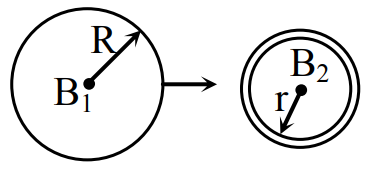
For N turns: $B_2 = \dfrac{\mu_0NI}{2r} = \dfrac{\mu_0(2I)}{2(R/2)} = 4 \times \dfrac{\mu_0I}{2R}$
$B_2 = 4B$
In general, rewinding into n turns gives $n^2B$.