Looking for classes? Ksquare Career Institute, Bengaluru →

Moving Charges and Magnetism
Lorentz Force
10 questions from 8 papers, each with its answer.
- questions
- 10
- papers
- 8
- years asked, 2017–2026
- 1 of 10
- of Moving Charges and Magnetism
- 11.24%
Appears in
Concepts tested
- Lorentz force 2
- Cyclotron period
- Direction of magnetic force
- Electric and magnetic forces on a proton
- force on an electron near a current-carrying wire
- Lorentz force on a stationary charge
- Lorentz magnetic force
- magnetic field from force and velocity vectors
- Magnetic force does no work
All Questions
2021 2 questions
-
An infinitely long straight conductor carries a current of 5 A as shown. An electron is moving with a speed of $10^5\ m/s$ parallel to the conductor. The perpendicular distance between the electron and the conductor is 20 cm at an instant. Calculate the magnitude of the force experienced by the electron at that instant.
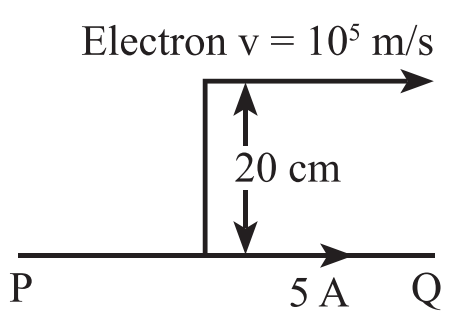
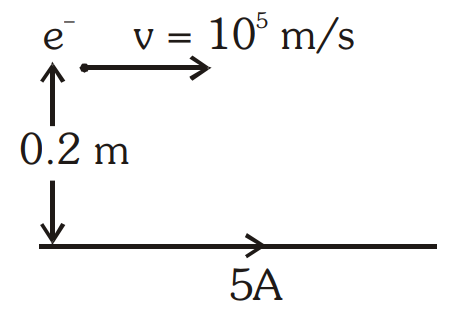 Field due to the wire at the electron: $B = \frac{\mu_0 i}{2\pi r}$
$F = evB = ev\left(\frac{\mu_0 i}{2\pi r}\right) = \frac{1.6 \times 10^{-19} \times 10^5 \times 2 \times 10^{-7} \times 5}{0.2}$
$F = 8 \times 10^{-20}$ N -
In the product $\vec{F}=q(\vec{v}\times\vec{B})=q\vec{v}\times(B\hat{i}+B\hat{j}+B_0\hat{k})$. For $q=1$ and $\vec{v}=2\hat{i}+4\hat{j}+6\hat{k}$ and $\vec{F}=4\hat{i}-20\hat{j}+12\hat{k}$. What will be the complete expression for $\vec{B}$?$\vec{F} = q(\vec{v} \times \vec{B})$ with q = 1: $4\hat{i} - 20\hat{j} + 12\hat{k} = \begin{vmatrix} \hat{i} & \hat{j} & \hat{k} \\ 2 & 4 & 6 \\ B & B & B_0 \end{vmatrix}$ Comparing components: $4 = 4B_0 - 6B$, $-20 = -2B_0 + 6B$, $12 = 2B - 4B$ Solving: B = –6, $B_0 = -8$ $\vec{B} = -6\hat{i} - 6\hat{j} - 8\hat{k}$
2013 NEET 1 question
-
When a proton is released from rest in a room, it starts with an initial acceleration $a_0$ towards west. When it is projected towards north with a speed $v_0$ it moves with an initial acceleration $3a_0$ towards west. The electric and magnetic fields in the room are:$\vec a = \frac{q}{m}(\vec E + \vec v\times\vec B)$
Released from rest: $\vec a = \frac{q}{m}\vec E = a_0$ (west) $\Rightarrow E = \frac{ma_0}{e}$ (west)
Projected north, the acceleration due to the magnetic force $= 3a_0 - a_0 = 2a_0$ (west)
$ev_0B = 2ma_0 \Rightarrow B = \frac{2ma_0}{ev_0}$ (down)
2010 AIPMT-MAINS 1 question
-
Two identical bar magnets are fixed with their centres at a distance d apart. A stationary charge Q is placed at P in between the gap of the two magnets at a distance D from the centre O as shown in the figure.
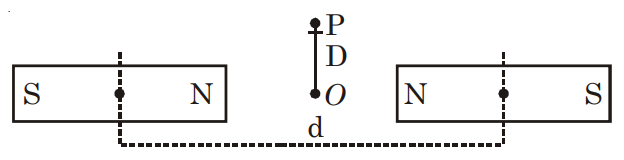
The force on the charge Q isMagnetic force on a charge: $\vec{F} = Q(\vec{v}\times\vec{B})$
The charge is stationary, so v = 0.
$F = QvB\sin\theta = 0$, whatever the magnetic field at P due to the two magnets may be.
A magnetic field exerts a force only on a moving charge; a steady magnet produces no electric field to act on a charge at rest.
Hence the force on the charge Q is zero.
2009 AIPMT 2 questions
-
The magnetic force acting on a charged particle of charge –2 $\mu$C in a magnetic field of 2 T acting in y direction, when the particle velocity is $(2\hat{i} + 3\hat{j})\times10^6$ m $s^{-1}$, is$\vec{F} = q(\vec{v}\times\vec{B})$ with $q = -2\times10^{-6}$ C, $\vec{v} = (2\hat{i} + 3\hat{j})\times10^6$ m/s, $\vec{B} = 2\hat{j}$ T
$\vec{v}\times\vec{B} = (2\hat{i} + 3\hat{j})\times10^6\times2\hat{j} = 4\times10^6(\hat{i}\times\hat{j}) + 6\times10^6(\hat{j}\times\hat{j})$
$\hat{i}\times\hat{j} = \hat{k}$ and $\hat{j}\times\hat{j} = 0$, so $\vec{v}\times\vec{B} = 4\times10^6\hat{k}$
$\vec{F} = -2\times10^{-6}\times4\times10^6\hat{k} = -8\hat{k}$ N
The force is 8 N in the –z direction.
Note: the first two options are printed identically in the source ('8N in z – direction'); the minus sign of one has been lost. They are taken here as +z and –z, with –z as the keyed answer. -
Under the influence of a uniform magnetic field, a charged particle moves with constant speed v in a circle of radius R. The time period of rotation of the particleThe magnetic force provides the centripetal force: $qvB = \frac{mv^2}{R}$, so $R = \frac{mv}{qB}$
Time period: $T = \frac{2\pi R}{v} = \frac{2\pi}{v}\times\frac{mv}{qB}$
$T = \frac{2\pi m}{qB}$
T depends only on the mass, the charge and the field; v and R cancel out (a faster particle moves in a proportionately bigger circle).
Hence the time period is independent of both v and R.
2006 AIPMT-PRE 1 question
-
When a charged particle moving with velocity $\vec{V}$ is subjected to a magnetic field of induction $\vec{B}$, the force on it is non-zero. This implies that :-Magnetic force on a moving charge: $\vec{F} = q(\vec{V} \times \vec{B})$
Its magnitude is $F = qVB\sin\theta$, where $\theta$ is the angle between $\vec{V}$ and $\vec{B}$.
When $\theta = 0^\circ$ or $\theta = 180^\circ$, $\sin\theta = 0$ and therefore $F = 0$.
For every other value of $\theta$, $\sin\theta \neq 0$ and the force is non-zero.
The force is maximum at $\theta = 90^\circ$, but it is not necessary that the angle be $90^\circ$ for the force to be non-zero.
So a non-zero force implies that the angle between $\vec{V}$ and $\vec{B}$ can have any value other than zero and $180^\circ$.
2005 AIPMT 1 question
-
A very long straight wire carries a current I. At the instant when a charge $+Q$ at point P has velocity $\vec{V}$, as shown, the force on the charge is -
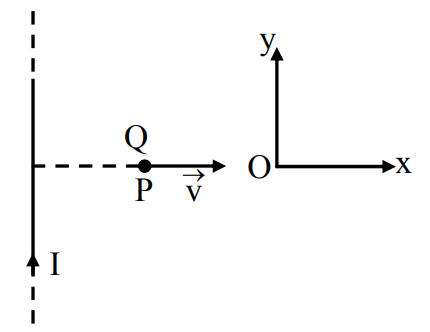 The magnetic force on a moving charge is $\vec{F} = Q(\vec{v} \times \vec{B})$.
In the figure the velocity of the charge is along the x-axis ($\hat{i}$), and at P the magnetic field of the straight current-carrying wire (given by the right hand thumb rule) points into the plane of the paper, i.e. along $-\hat{k}$.
$\vec{F} = QvB(\hat{i} \times (-\hat{k}))$
Since $\hat{i} \times \hat{k} = -\hat{j}$, we get $\hat{i} \times (-\hat{k}) = +\hat{j}$.
$\vec{F} = QvB\,\hat{j}$
So the force on the charge is along OY.
2003 AIPMT 1 question
-
A charged particle moves through a magnetic field in a direction perpendicular to it. Then theMagnetic force on a moving charge: $\vec{F} = q(\vec{v} \times \vec{B})$. This force is always perpendicular to the velocity $\vec{v}$.
A force perpendicular to the velocity does no work, so the kinetic energy and hence the speed of the particle remain constant.
The force continuously changes the direction of motion, so the particle moves in a circle. Its velocity (a vector) and its acceleration (directed towards the centre, changing in direction) both change.
So the speed of the particle remains unchanged.
2002 AIPMT 1 question
-
A charge 'q' moves in a region where electric field and magnetic field both exist, then force on it is : -The total force on a charge in combined electric and magnetic fields is the Lorentz force: $\vec{F}_L = \vec{F}_e + \vec{F}_m$
Electric force: $\vec{F}_e = q\vec{E}$
Magnetic force: $\vec{F}_m = q(\vec{V} \times \vec{B})$ (note the order: velocity first, then field)
$\vec{F}_L = q\vec{E} + q(\vec{V} \times \vec{B})$