Looking for classes? Ksquare Career Institute, Bengaluru →

Moving Charges and Magnetism
Biot-Savart Law – Field due to Straight Wires and Arc
5 questions from 5 papers, each with its answer.
- questions
- 5
- papers
- 5
- years asked, 2017–2026
- 2 of 10
- of Moving Charges and Magnetism
- 5.62%
Appears in
Concepts tested
- Biot-Savart law vs Coulomb's law
- field at centre of semicircular bend
- Field due to straight wires and semicircle
- Perpendicular fields
- Superposition of fields of parallel wires
All Questions
2023 1 question
-
A very long conducting wire is bent in a semi-circular shape from A to B as shown in figure. The magnetic field at point P for steady current configuration is given by:
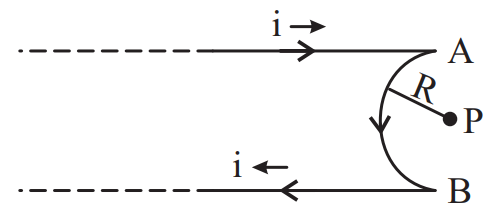
Semicircle gives $\frac{\mu_0 i}{4R}$ and the two straight wires each give $\frac{\mu_0 i}{4\pi R}$ in the opposite sense.
$\vec{B}_P=\vec{B}_{upper\ wire}\otimes+\vec{B}_{semi-circle}\odot+\vec{B}_{lower\ wire}\otimes$ $B_P=-\frac{\mu_0 i}{4\pi R}+\frac{\mu_0 i}{4R}-\frac{\mu_0 i}{4\pi R}$ $=\frac{\mu_0 i}{4R}\left(1-\frac{2}{\pi}\right)$ pointing away from the page
2022 1 question
-
Given below are two statements : Statement I : Biot-Savart's law gives us the expression for the magnetic field strength of an infinitesimal current element ($I\,d\vec{l}$) of the current carrying conductor only. Statement II : Biot-Savart's law is analogous to Coulomb's inverse square law of charge $q$, with the former being related to the field produced by a scalar source, $I\,d\vec{l}$, while the latter being produced by a vector source, $q$. In light of above statements choose the most appropriate answer from the options given belowBy Biot-Savart's law, $d\vec{B} = \frac{\mu_0}{4\pi}\frac{I\,d\vec{\ell} \times \vec{r}}{r^3}$ It gives the magnetic field due to an infinitesimal current element $I\,d\vec{\ell}$ – Statement I is correct. The current element $I\,d\vec{\ell}$ is a vector source, while charge q is a scalar source – so Statement II (which says the opposite) is incorrect. So Statement I is correct and Statement II is incorrect.
2015 AIPMT-I 1 question
-
A wire carrying current I has the shape as shown in adjoining figure. Linear parts of the wire are very long and parallel to X-axis, while semicircular portion of radius R is lying in Y–Z plane. Magnetic field at point O is
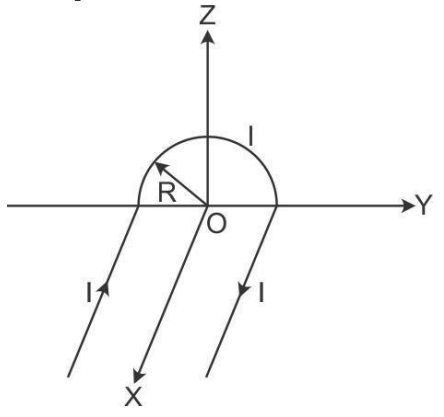 Field of a straight wire: $B = \frac{\mu_0 I}{4\pi R}(\sin\phi_1 + \sin\phi_2)$
Each semi-infinite straight part gives $\frac{\mu_0 I}{4\pi R}(\sin 90^\circ + \sin 0^\circ) = \frac{\mu_0 I}{4\pi R}$ along $-\hat k$.
$\vec B_L = 2\times\frac{\mu_0 I}{4\pi R}(-\hat k)$
Semicircular part: $\vec B_S = \frac{1}{2}\cdot\frac{\mu_0 I}{2R}(-\hat i) = \frac{\mu_0 I\pi}{4\pi R}(-\hat i)$
$\vec B = \vec B_L + \vec B_S = -\frac{\mu_0 I}{4\pi R}(\pi\hat i + 2\hat k)$
2014 AIPMT 1 question
-
Two identical long conducting wires AOB and COD are placed at right angle to each other, with one above other such that 'O' is their common point for the two. The wires carry $I_1$ and $I_2$ currents respectively. Point 'P' is lying at distance 'd' from 'O' along a direction perpendicular to the plane containing the wires. The magnetic field at the point 'P' will be:The fields of the two wires at P are perpendicular: $B = \sqrt{B_1^2 + B_2^2}$
$B = \sqrt{\left(\frac{\mu_0I_1}{2\pi d}\right)^2 + \left(\frac{\mu_0I_2}{2\pi d}\right)^2} = \frac{\mu_0}{2\pi d}\sqrt{I_1^2 + I_2^2}$
2000 AIPMT 1 question
-
For adjoining fig., the magnetic field at point 'P' will be :
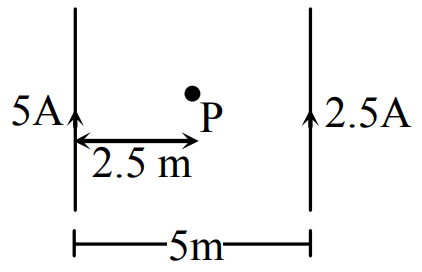 Magnetic field of a long straight wire: $B = \dfrac{\mu_0I}{2\pi r}$
Due to the 5 A wire at 2.5 m: $B_1 = \dfrac{5\mu_0}{2\pi \times 2.5} = \dfrac{2\mu_0}{2\pi}$, directed into the page ($\otimes$) at P.
Due to the 2.5 A wire at 2.5 m: $B_2 = \dfrac{2.5\mu_0}{2\pi \times 2.5} = \dfrac{\mu_0}{2\pi}$, directed out of the page at P (opposite, since P is on the other side of this wire).
Resultant: $B = \dfrac{2\mu_0}{2\pi} - \dfrac{\mu_0}{2\pi} = \dfrac{\mu_0}{2\pi}$, into the page ($\otimes$).