Looking for classes? Ksquare Career Institute, Bengaluru →

Physics
Oscillations
63 questions from 34 papers, each with its answer.
- 63 questions
- 34 papers
- 3.57% of Physics
Simple Harmonic Motion – Amplitude
-
The displacement of a particle executing simple harmonic motion is given by $y=A_0+A\sin\omega t+B\cos\omega t$. Then the amplitude of its oscillation is given by:$y=A_0+A\sin\omega t+B\cos\omega t$ Shifting origin: $y'=y-A_0=A\sin\omega t+B\cos\omega t$ The two SHMs have a phase difference of $90^\circ$, so the resultant amplitude is $R=\sqrt{A^2+B^2+2AB\cos90^\circ}=\sqrt{A^2+B^2}$
Simple Harmonic Motion – Velocity
-
Average velocity of a particle executing SHM in one complete vibration is:In one complete vibration, the particle returns to its initial position, so displacement is zero. Average velocity $=\frac{\text{Displacement}}{\text{Time interval}}=\frac{y_f-y_i}{T}=\frac{0}{T}=0$
Simple Harmonic Motion and Uniform Circular Motion
-
The radius of circle, the period of revolution, initial position and sense of revolution are indicated in the fig. $y$-projection of the radius vector of rotating particle $P$ is:
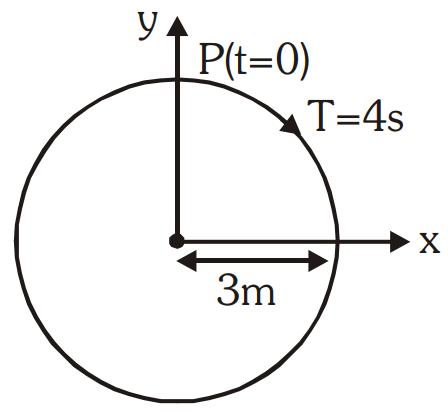
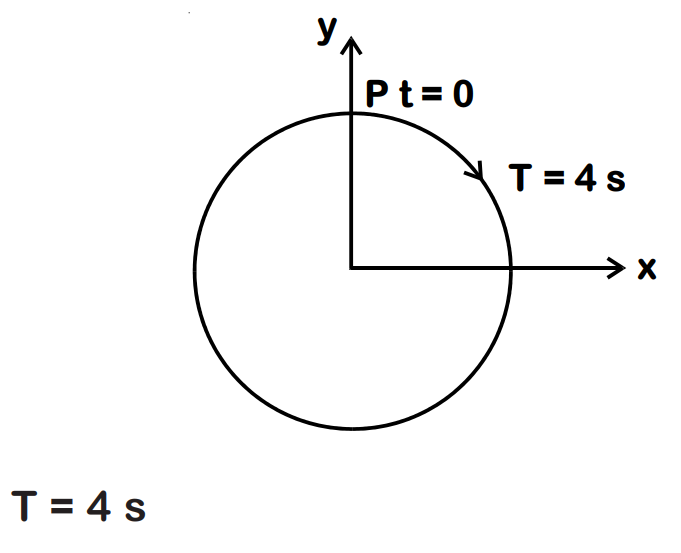
At $t=0$ the y-displacement is maximum, so the equation is a cosine function: $y=a\cos\omega t$
$\omega=\frac{2\pi}{T}=\frac{2\pi}{4}=\frac{\pi}{2}\ rad/s$, $a=3\ m$
$y(t)=3\cos\left(\frac{\pi t}{2}\right)$
That is every question in Oscillations for this filter.
Want a score?
Answers here are not saved. Practise as a test to be marked and see your progress.
Practise as a test