2004 AIPMT OscillationsCombination of springs Easy Question 2 of 3 in Combination of springs

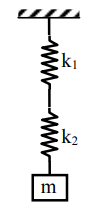
Two springs of spring constants $k_1$ and $k_2$ are joined in series. The effective spring constant of the combination is given by -

A $\dfrac{(k_1 + k_2)}{2}$
B $k_1 + k_2$
C $\dfrac{k_1k_2}{(k_1 + k_2)}$
D $\sqrt{k_1k_2}$

The answer is C.
Solution

When springs are joined in series, the same force F acts in each spring, and the total extension is the sum of the individual extensions.
$x = x_1 + x_2 \Rightarrow \dfrac{F}{k_{eff}} = \dfrac{F}{k_1} + \dfrac{F}{k_2}$
So in series: $\dfrac{1}{k_{eff}} = \dfrac{1}{k_1} + \dfrac{1}{k_2} + \dots$
For two springs: $\dfrac{1}{k_{eff}} = \dfrac{k_1 + k_2}{k_1 k_2}$
$\Rightarrow k_{eff} = \dfrac{k_1 k_2}{k_1 + k_2}$

(For springs in parallel the constants would simply add: $k_{eff} = k_1 + k_2$.)

Concept Springs in series

Combination of springs in past papers

3 questions from this chapter have appeared across 3 exam years.
