Looking for classes? Ksquare Career Institute, Bengaluru →

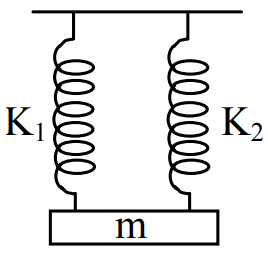
A mass is suspended separately by two different springs in successive order then time period is $t_1$ and $t_2$ respectively. If it is connected by both springs as shown in figure then time period is $t_0$, the correct relation is : -
A
$t_0^2 = t_1^2 + t_2^2$
B
$t_0^{-2} = t_1^{-2} + t_2^{-2}$
C
$t_0^{-1} = t_1^{-1} + t_2^{-1}$
D
$t_0 = t_1 + t_2$
Detailed Solution
Time period of a spring-mass system: $T = 2\pi\sqrt{\dfrac{m}{K}}$, so $K = \dfrac{4\pi^2 m}{T^2}$, i.e. $K \propto \dfrac{1}{T^2}$ for the same mass.
With spring $K_1$ alone: $K_1 \propto \dfrac{1}{t_1^2}$; with $K_2$ alone: $K_2 \propto \dfrac{1}{t_2^2}$.
In the figure both springs support the mass side by side, so they are in parallel and their constants add: $K = K_1 + K_2$.
$\dfrac{1}{t_0^2} = \dfrac{1}{t_1^2} + \dfrac{1}{t_2^2}$
$\Rightarrow t_0^{-2} = t_1^{-2} + t_2^{-2}$
With spring $K_1$ alone: $K_1 \propto \dfrac{1}{t_1^2}$; with $K_2$ alone: $K_2 \propto \dfrac{1}{t_2^2}$.
In the figure both springs support the mass side by side, so they are in parallel and their constants add: $K = K_1 + K_2$.
$\dfrac{1}{t_0^2} = \dfrac{1}{t_1^2} + \dfrac{1}{t_2^2}$
$\Rightarrow t_0^{-2} = t_1^{-2} + t_2^{-2}$