2016 Ray Optics and Optical InstrumentsSpherical mirrors – magnification and nature of image Medium Question 44 of 89 in Ray Optics and Optical Instruments

Match the corresponding entries of Column 1 with Column 2. [Where m is the magnification produced by the mirror]
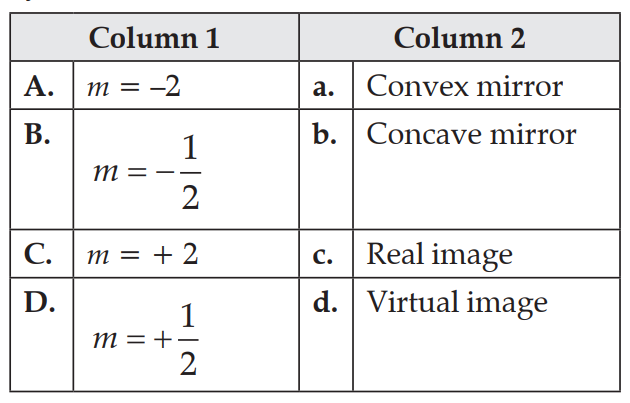
Match the corresponding entries of Column 1 with Column 2. [Where m is the magnification produced by the mirror]
A A → a and c; B → a and d; C → a and b; D → c and d
B A → a and d; B → b and c; C → b and d; D → b and c
C A → c and d; B → b and d; C → b and c; D → a and d
D A → b and c; B → b and c; C → a and d; D → a and d

The answer is D.

Solution

Negative m = real image; positive m = virtual image; |m| > 1 with virtual image needs a concave mirror.

Magnification for a mirror $m = -\frac{v}{u}$
For A (m = –2): v = 2u; u and v have the same sign, so the mirror is concave and the image is real: A → b, c
For B (m = –1/2): 2v = u; same sign, image real, concave mirror: B → b, c
For C (m = +2): v = –2u; u and v have opposite signs, the image is virtual; the source takes the mirror as convex: C → a, d
For D (m = +1/2): v = –u/2; opposite signs and magnification less than 1, so the mirror is convex and the image is virtual: D → a, d
Note: the source key gives this combination. A virtual image with m = +2 (magnified) is actually formed only by a concave mirror, so C should strictly be 'b and d'; please check this key before use.

Concept mirror-magnification-nature

Ray Optics and Optical Instruments in past papers

89 questions from this chapter have appeared across 25 exam years.
