Looking for classes? Ksquare Career Institute, Bengaluru →

Physics
System of Particles and Rotational Motion
100 questions from 38 papers, each with its answer.
- 100 questions
- 38 papers
- 5.67% of Physics
Centre of mass of a system of particles
-
Three identical spheres, each of mass M, are placed at the corners of a right angle triangle with mutually perpendicular sides equal to 2 m (see figure). Taking the point of intersection of the two mutually perpendicular sides as the origin, find the position vector of centre of mass.
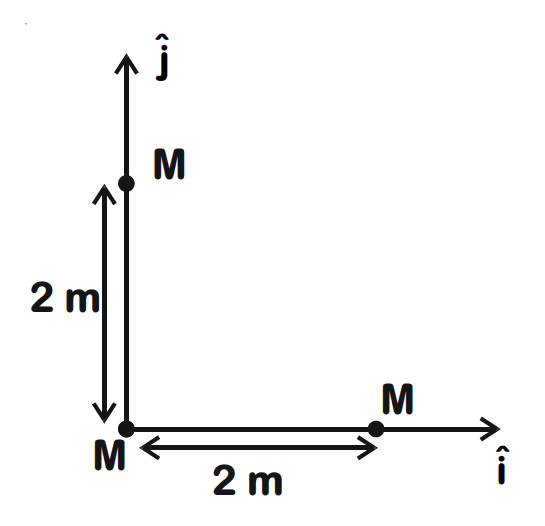 With masses at the origin, at $(2,0)$ and at $(0,2)$ (all mass M): $x_{cm}=\dfrac{M(0)+M(2)+M(0)}{3M}=\dfrac{2}{3}$, similarly $y_{cm}=\dfrac{2}{3}$. So position vector of COM $=\dfrac{2}{3}(\hat i+\hat j)$.
Angular acceleration
-
The angular speed of the wheel of a vehicle is increased from 360 rpm to 1200 rpm in 14 second. Its angular acceleration is,$\omega_1=360$ rpm $=\dfrac{360\times2\pi}{60}=12\pi\ rad/s$. $\omega_2=1200$ rpm $=\dfrac{1200\times2\pi}{60}=40\pi\ rad/s$. $\alpha=\dfrac{\omega_2-\omega_1}{t}=\dfrac{40\pi-12\pi}{14}=\dfrac{28\pi}{14}=2\pi\ rad/s^2$.
That is every question in System of Particles and Rotational Motion for this filter.
Want a score?
Answers here are not saved. Practise as a test to be marked and see your progress.
Practise as a test