Looking for classes? Ksquare Career Institute, Bengaluru →

Physics
System of Particles and Rotational Motion
100 questions from 38 papers, each with its answer.
- 100 questions
- 38 papers
- 5.67% of Physics
Moment of inertia – disc with a hole (parallel axis theorem)
-
From a disc of radius R and mass M, a circular hole of diameter R, whose rim passes through the centre is cut. What is the moment of inertia of the remaining part of the disc about a perpendicular axis, passing through the centre?
Subtract the hole's MI (via parallel axis theorem) from the full disc.
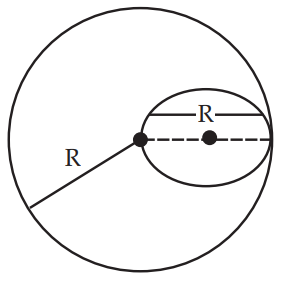
Mass per unit area $\rho = \frac{M}{\pi R^2}$; mass of removed part $M' = \rho\pi\left(\frac{R}{2}\right)^2 = \frac{M}{4}$
By the parallel axis theorem, MI of removed part about the centre: $I_1 = \frac{1}{2}M'\left(\frac{R}{2}\right)^2 + M'\left(\frac{R}{2}\right)^2 = \frac{MR^2}{32} + \frac{MR^2}{16} = \frac{3MR^2}{32}$
MI of the full disc about the centre $I = \frac{MR^2}{2}$
$I_{net} = I - I_1 = \frac{16MR^2}{32} - \frac{3MR^2}{32} = \frac{13MR^2}{32}$
Rolling motion on an inclined plane
-
A disc and a sphere of same radius but different masses roll off on two inclined planes of the same altitude and length. Which one of the two objects gets to the bottom of the plane first?
$a = g\sin\theta/(1 + k^2/R^2)$; the sphere has smaller $k^2/R^2$.
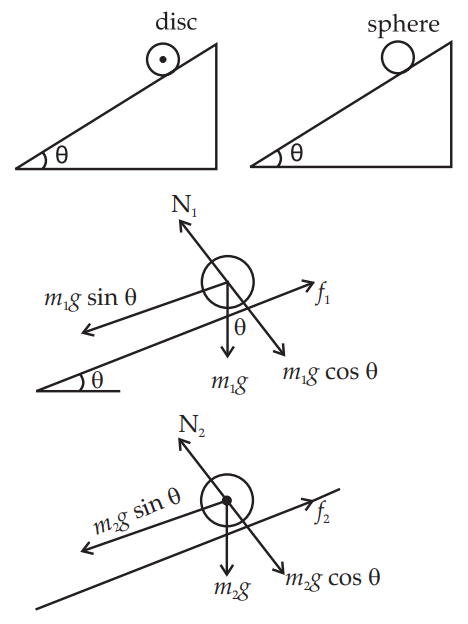
For the disc ($I_1 = \frac{1}{2}m_1R^2$): $m_1g\sin\theta - f_1 = m_1a_1$ and $f_1R = I_1\alpha_1$, giving $a_1 = \frac{2}{3}g\sin\theta$
For the sphere ($I_2 = \frac{2}{5}m_2R^2$): $m_2g\sin\theta - f_2 = m_2a_2$ and $f_2R = I_2\alpha_2$, giving $a_2 = \frac{5}{7}g\sin\theta$
$\frac{5}{7}g\sin\theta > \frac{2}{3}g\sin\theta$, so $a_2 > a_1$
Hence the sphere reaches the bottom first.
Rotational kinematics – centripetal and tangential acceleration
-
A uniform circular disc of radius 50 cm at rest is free to turn about an axis which is perpendicular to its plane and passes through its centre. It is subjected to a torque which produces a constant angular acceleration of 2.0 rad $s^{-2}$. Its net acceleration in $ms^{-2}$ at the end of 2.0 s is approximately
Combine centripetal and tangential components at the rim.
$\omega = \omega_0 + \alpha t = 0 + 2\times2 = 4$ rad/s
Centripetal acceleration $a_c = R\omega^2 = 0.5\times16 = 8\ m/s^2$
Tangential acceleration $a_t = R\alpha = 0.5\times2 = 1\ m/s^2$
$a_{net} = \sqrt{a_c^2 + a_t^2} = \sqrt{64 + 1} = \sqrt{65} \approx 8\ m/s^2$
That is every question in System of Particles and Rotational Motion for this filter.
Want a score?
Answers here are not saved. Practise as a test to be marked and see your progress.
Practise as a test