Looking for classes? Ksquare Career Institute, Bengaluru →

Physics
Ray Optics and Optical Instruments
89 questions from 36 papers, each with its answer.
- 89 questions
- 36 papers
- 5.05% of Physics
Astronomical telescope – object at finite distance
-
A astronomical telescope has objective and eyepiece of focal lengths 40 cm and 4 cm respectively. To view an object 200 cm away from the objective, the lenses must be separated by a distance
Tube length = $v_o + f_e$ in normal adjustment.
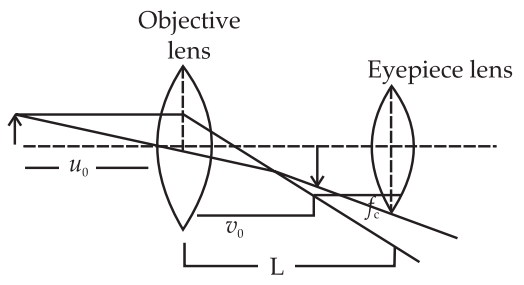
For the objective: $\frac{1}{v_o} - \frac{1}{u_o} = \frac{1}{f_o} \Rightarrow \frac{1}{v_o} - \frac{1}{(-200)} = \frac{1}{40}$
$\frac{1}{v_o} = \frac{1}{40} - \frac{1}{200} = \frac{4}{200} \Rightarrow v_o = 50$ cm
For normal adjustment, distance between lenses $l = v_o + f_e = 50 + 4 = 54$ cm
Spherical mirrors – magnification and nature of image
-
Match the corresponding entries of Column 1 with Column 2. [Where m is the magnification produced by the mirror]
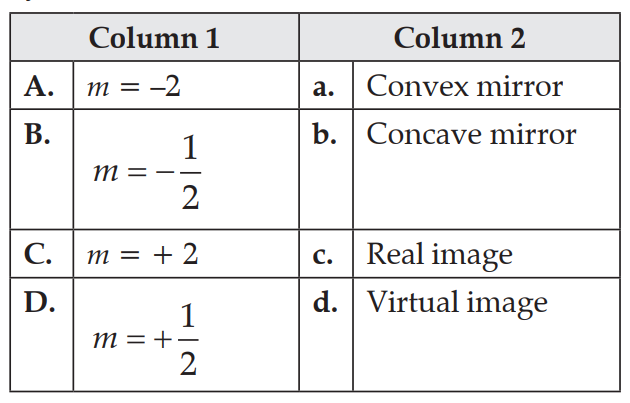
Negative m = real image; positive m = virtual image; |m| > 1 with virtual image needs a concave mirror.
Magnification for a mirror $m = -\frac{v}{u}$
For A (m = –2): v = 2u; u and v have the same sign, so the mirror is concave and the image is real: A → b, c
For B (m = –1/2): 2v = u; same sign, image real, concave mirror: B → b, c
For C (m = +2): v = –2u; u and v have opposite signs, the image is virtual; the source takes the mirror as convex: C → a, d
For D (m = +1/2): v = –u/2; opposite signs and magnification less than 1, so the mirror is convex and the image is virtual: D → a, d
Note: the source key gives this combination. A virtual image with m = +2 (magnified) is actually formed only by a concave mirror, so C should strictly be 'b and d'; please check this key before use.
Prism – minimum deviation
-
The angle of incidence for a ray of light at a refracting surface of a prism is 45°. The angle of prism is 60°. If the ray suffers minimum deviation through the prism, the angle of minimum deviation and refractive index of the material of the prism respectively, are
At minimum deviation i = e; then use the prism formula.
For minimum deviation, i = e = 45°, so $\delta_m = i + e - A = 45^\circ + 45^\circ - 60^\circ = 30^\circ$
$\mu = \frac{\sin\left(\frac{A + \delta_m}{2}\right)}{\sin\left(\frac{A}{2}\right)} = \frac{\sin45^\circ}{\sin30^\circ} = \frac{1/\sqrt{2}}{1/2}$
$\mu = \sqrt{2}$
That is every question in Ray Optics and Optical Instruments for this filter.
Want a score?
Answers here are not saved. Practise as a test to be marked and see your progress.
Practise as a test