Looking for classes? Ksquare Career Institute, Bengaluru →

Physics
Ray Optics and Optical Instruments
89 questions from 36 papers, each with its answer.
- 89 questions
- 36 papers
- 5.05% of Physics
Refraction through a Prism
-
Find the value of the angle of emergence from the prism. Refractive index of the glass is $\sqrt{3}$.
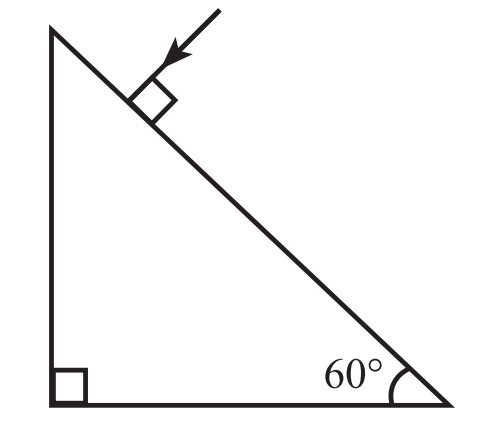 The ray enters normally, so $r_1 = 0^\circ$. Prism angle A = $30^\circ$, so $r_2 = A - r_1 = 30^\circ$.
Snell's law at the second face: $\sqrt{3}\sin 30^\circ = 1 \times \sin e$
$\sin e = \frac{\sqrt{3}}{2} \Rightarrow e = 60^\circ$
Optical Instruments – Astronomical Telescope
-
A lens of large focal length and large aperture is best suited as an objective of an astronomical telescope since:Magnifying power $MP = \frac{f_o}{f_e}$ – a large focal length of the objective gives higher magnification. Resolving power $RP = \frac{a}{1.22\lambda}$ – a large aperture gives better resolution and hence better quality of image. A large area of the objective also gathers more light, improving visibility. So all of the above reasons are correct.
Combination of Lenses – Telescopic Arrangement
-
A convex lens 'A' of focal length 20 cm and a concave lens 'B' of focal length 5 cm are kept along the same axis with a distance 'd' between them. If a parallel beam of light falling on 'A' leaves 'B' as a parallel beam, then the distance 'd' in cm will be:
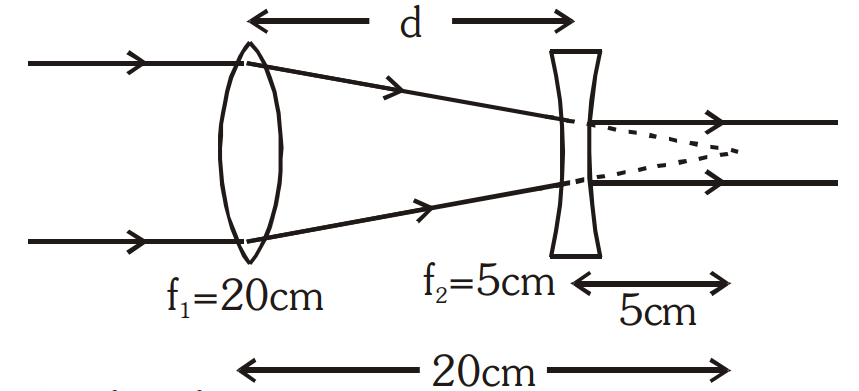
For a parallel beam to emerge parallel, the second focal point of A must coincide with the focal point of B (on the far side of B).
$d = f_1 - f_2 = 20 - 5 = 15$ cm
Refraction by Lenses and Reflection by a Plane Mirror
-
A point object is placed at a distance of 60 cm from a convex lens of focal length 30 cm. If a plane mirror were put perpendicular to the principal axis of the lens and at a distance of 40 cm from it, the final image would be formed at a distance of:
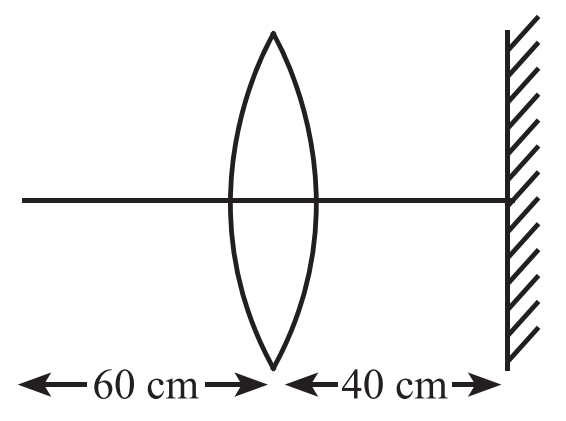 Refraction by the lens: u = –60 cm, f = +30 cm ⇒ $v = \frac{uf}{u + f} = \frac{-60 \times 30}{-60 + 30} = 60$ cm
This image is 20 cm behind the mirror and acts as a virtual object;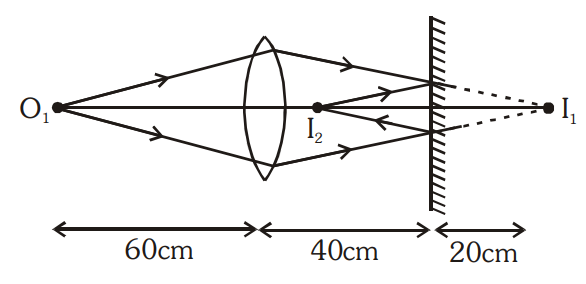
the mirror forms a real image 20 cm in front of it, i.e. 20 cm from the lens.
Refraction again by the lens (light travelling back): u = –20 cm, f = +30 cm ⇒ $v = \frac{-20 \times 30}{-20 + 30} = -60$ cm So the final image is virtual, 60 cm from the lens,
i.e. 20 cm behind the plane mirror.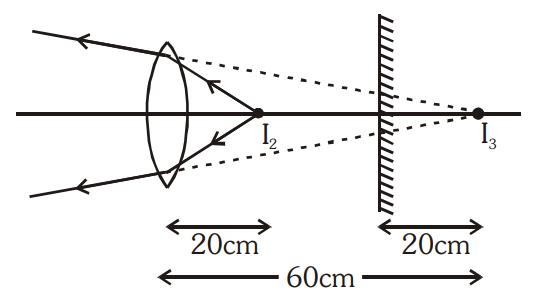
That is every question in Ray Optics and Optical Instruments for this filter.
Want a score?
Answers here are not saved. Practise as a test to be marked and see your progress.
Practise as a test