Looking for classes? Ksquare Career Institute, Bengaluru →

Physics
Current Electricity
130 questions from 38 papers, each with its answer.
- 130 questions
- 38 papers
- 7.37% of Physics
Combination of Resistors
-
The effective resistance of a parallel connection that consists of four wires of equal length, equal area of cross-section and same material is $0.25\ \Omega$. What will be the effective resistance if they are connected in series?In parallel: $R_{eq} = \frac{R}{4} = 0.25\ \Omega \Rightarrow R = 1\ \Omega$ (each wire) In series: $R_{series} = 4R = 4 \times 1 = 4\ \Omega$
Potentiometer
-
In a potentiometer circuit a cell of EMF 1.5 V gives balance point at 36 cm length of wire. If another cell of EMF 2.5 V replaces the first cell, then at what length of the wire, the balance point occurs?For a potentiometer, $E \propto \ell$: $\frac{E_1}{E_2} = \frac{\ell_1}{\ell_2}$ $\frac{1.5}{2.5} = \frac{36}{\ell_2} \Rightarrow \ell_2 = 36 \times \frac{5}{3} = 60$ cm
Drift of Electrons and the Origin of Resistivity
-
Column-I gives certain physical terms associated with flow of current through a metallic conductor. Column-II gives some mathematical relations involving electrical quantities. Match Column-I and Column-II with appropriate relations.
Pick the matching item from Column II for each row.
Column I
- A. Drift Velocity
- B. Electrical Resistivity
- C. Relaxation Period
- D. Current Density
Column II
- P. $\frac{m}{ne^2\rho}$
- Q. $nev_d$
- R. $\frac{eE}{m}\tau$
- S. $\frac{E}{J}$
Correct answer: A → R, B → S, C → P, D → Q
Drift velocity: $v_d = \left(\frac{eE}{m}\right)\tau$ Resistivity: $J = \sigma E = \frac{E}{\rho} \Rightarrow \rho = \frac{E}{J}$ Relaxation period: $\rho = \frac{E}{nev_d}$ and $v_d = \frac{eE}{m}\tau$ give $\tau = \frac{m}{ne^2\rho}$ Current density: $i = neAv_d \Rightarrow J = \frac{i}{A} = nev_d$ Correct match: A-R, B-S, C-P, D-Q.
Combination of Resistors – Current Division
-
Three resistors having resistances $r_1$, $r_2$ and $r_3$ are connected as shown in the given circuit. The ratio $\frac{i_3}{i_1}$ of currents in terms of resistances used in the circuit is:
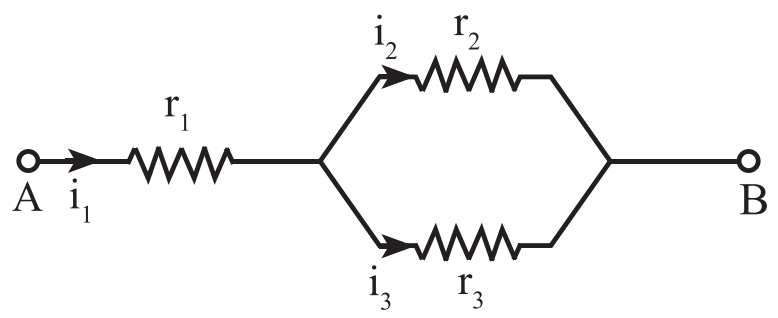
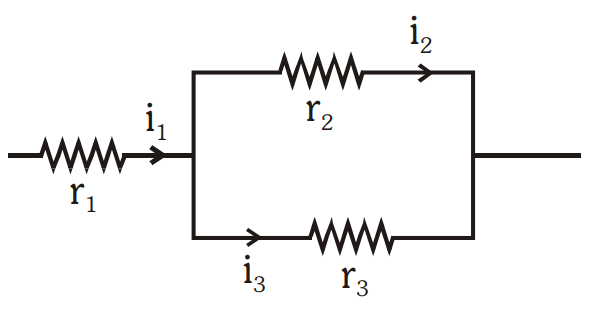
$r_2$ and $r_3$ are in parallel (same potential difference), so $i \propto \frac{1}{r}$: $\frac{i_2}{i_3} = \frac{r_3}{r_2}$
$i_1 = i_2 + i_3 \Rightarrow i_3 = \frac{r_2}{r_2 + r_3}i_1$
$\frac{i_3}{i_1} = \frac{r_2}{r_2 + r_3}$
That is every question in Current Electricity for this filter.
Want a score?
Answers here are not saved. Practise as a test to be marked and see your progress.
Practise as a test