Looking for classes? Ksquare Career Institute, Bengaluru →

Physics
Current Electricity
130 questions from 38 papers, each with its answer.
- 130 questions
- 38 papers
- 7.37% of Physics
Colour Code of Carbon Resistors
-
A carbon resistor of $(47 \pm 4.7)\ k\Omega$ is to be marked with rings of different colours for its identification. The colour code sequence will be
Digits 4, 7 = yellow, violet; ×10³ = orange; ±10% = silver.
$(47 \pm 4.7)\ k\Omega = 47 \times 10^{3}\ \Omega \pm 10\%$ 4 → Yellow, 7 → Violet, multiplier $10^3$ → Orange, tolerance 10% → Silver $\therefore$ Colour code: Yellow – Violet – Orange – Silver
Series and parallel combination of resistors with internal resistance
-
A set of 'n' equal resistors, of value 'R' each, are connected in series to a battery of emf 'E' and internal resistance 'R'. The current drawn is I. Now, the 'n' resistors are connected in parallel to the same battery. Then the current drawn from battery becomes 10 I. The value of 'n' is
The ratio of the two currents simplifies to n, so n = 10.
$I = \frac{E}{nR + R}$ ...(i) $10I = \frac{E}{\frac{R}{n} + R}$ ...(ii) Dividing (ii) by (i), $10 = \frac{(n+1)R}{\left(\frac{1}{n}+1\right)R} = n$ After solving the equation, $n = 10$
Cells in series and internal resistance
-
A battery consists of a variable number 'n' of identical cells (having internal resistance 'r' each) which are connected in series. The terminals of the battery are short-circuited and the current I is measured. Which of the graphs shows the correct relationship between I and n?
Short-circuit current $n\varepsilon/nr = \varepsilon/r$ does not depend on n.
$I = \frac{n\varepsilon}{nr} = \frac{\varepsilon}{r}$ So, I is independent of n and I is constant.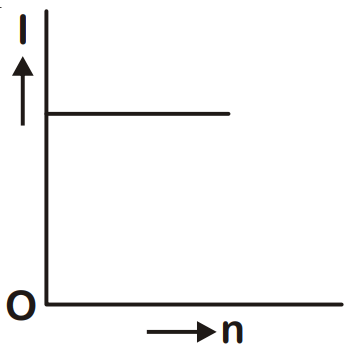 So the correct graph is a horizontal line (I constant for all n).
That is every question in Current Electricity for this filter.
Want a score?
Answers here are not saved. Practise as a test to be marked and see your progress.
Practise as a test