Looking for classes? Ksquare Career Institute, Bengaluru →

Physics
Current Electricity
130 questions from 38 papers, each with its answer.
- 130 questions
- 38 papers
- 7.37% of Physics
Symmetric resistor networks (Wheatstone-bridge-like circuits)
-
A uniform metallic wire having resistance $4\ \Omega$ is bent to form a square loop (ABCD) (see figure). A resistance of $2\ \Omega$ is connected between points B and D and a battery of 2 V is connected across points A and C as shown in the figure. Now the value of current (I) is:
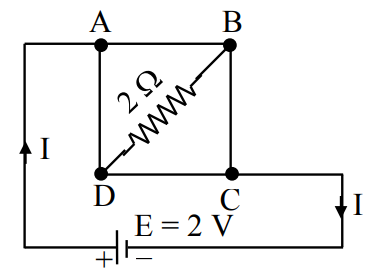 Resistance of each side of the square $= \frac{4}{4} = 1\ \Omega$ With the battery across A and C, the circuit is a balanced Wheatstone bridge, so no current flows through the $2\ \Omega$ resistor between B and D. The two paths (A-B-C and A-D-C) are each $2\ \Omega$ in parallel, so $R_{net} = 1\ \Omega$ $I = \frac{E}{R_{net}} = \frac{2}{1} = 2$ A
Conversion of galvanometer to ammeter (shunt resistance)
-
A galvanometer of resistance 100 $\Omega$ gives full scale deflection for a current of 1 mA. It is converted into an ammeter of range 0 - 10 A. The shunt required is:$R_g = 100\ \Omega$, $I_g = 1$ mA, I = 10 A $S = \frac{I_g R_g}{I - I_g} = \frac{10^{-3} \times 100}{10 - 10^{-3}}$ Since $I_g << I$, $I - I_g \approx I$ $S = 10^{-2} = 0.01\ \Omega$
Meter bridge / Wheatstone bridge - effect of interchanging cell and galvanometer
-
In a metre bridge experiment (see figure), the positions of the cell, E, and galvanometer, G, are interchanged. We shall observe in the galvanometer:
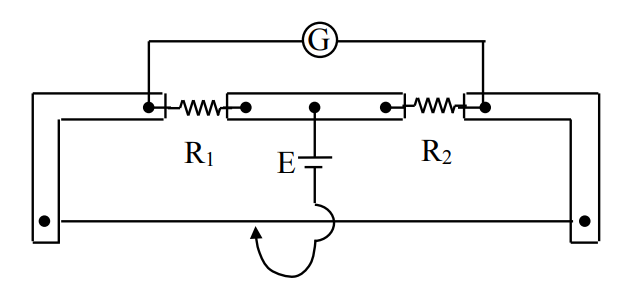 In the given circuit, it is not mentioned whether the metre bridge is balanced or not. So on interchanging the positions of the battery and galvanometer, the deflection may or may not be zero. In the unbalanced condition, the deflection may be left or right sided depending on the jockey position, and at the balance point there is no deflection.
Terminal voltage and internal resistance of a cell
-
A resistor is connected to a battery of 12 V emf and internal resistance $2\ \Omega$. If the current in the circuit is 0.6 A, the terminal voltage of the battery is:EMF E = 12 V, r = $2\ \Omega$, I = 0.6 A Terminal voltage $V = E - Ir = 12 - (0.6)(2)$ V = 10.8 volt
Electrical power, $P = V^2/R$
-
A room heater is rated 400 W, 220 V. If the supply voltage drops to 200 V, what will be the power consumed (approximately)?Rated voltage = 220 V, rated power = 400 W, supply voltage = 200 V Resistance of heater $R_H = \frac{(220)^2}{400}$ Actual power $P' = \frac{V_s^2}{R_H} = \frac{(200)^2}{(220)^2} \times 400$ $= 330.57$ W $\approx 331$ W
That is every question in Current Electricity for this filter.
Want a score?
Answers here are not saved. Practise as a test to be marked and see your progress.
Practise as a test