Looking for classes? Ksquare Career Institute, Bengaluru →

Physics
Semiconductor Electronics: Materials, Devices and Simple Circuits
106 questions from 34 papers, each with its answer.
- 106 questions
- 34 papers
- 6.01% of Physics
Ideal diode analysis in DC circuits
-
The current I in the circuit shown below is: (All diodes are ideal and identical)
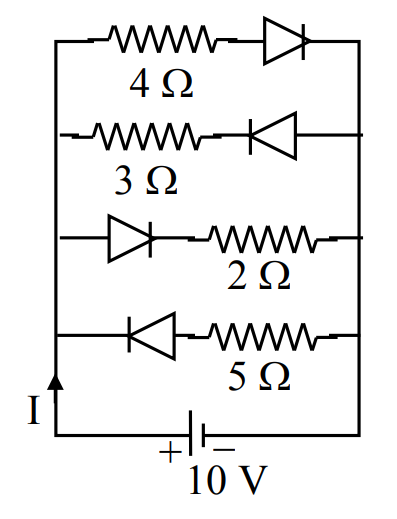
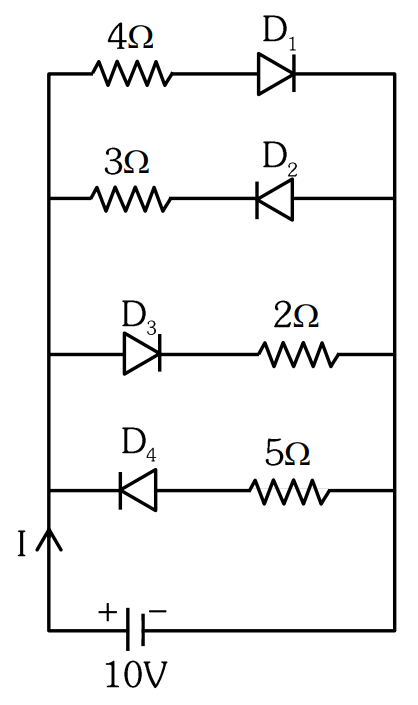 Here $D_1$ and $D_3$ are forward biased (act as closed switches), while $D_2$ and $D_4$ are reverse biased (open circuit).
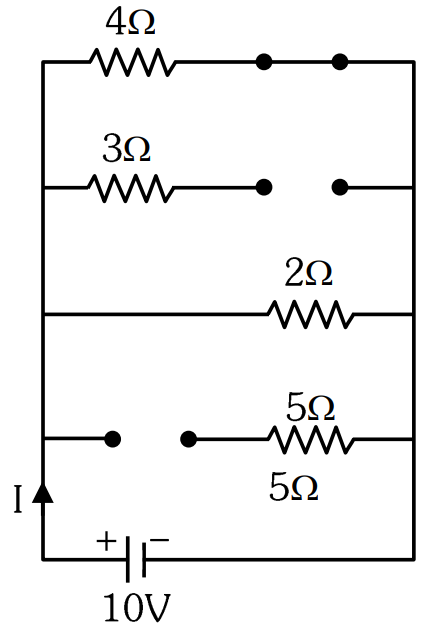 So only the $4\ \Omega$ and $2\ \Omega$ branches conduct, and they are in parallel:
$R_{eq} = \frac{4 \times 2}{4 + 2} = \frac{4}{3}\ \Omega$
$I = \frac{V}{R_{eq}} = \frac{10}{4/3} = \frac{15}{2}$ A
p-n junction diode as a half-wave rectifier/clipper
-
In the circuit shown below, the voltage appearing across the diode D will be of the form:
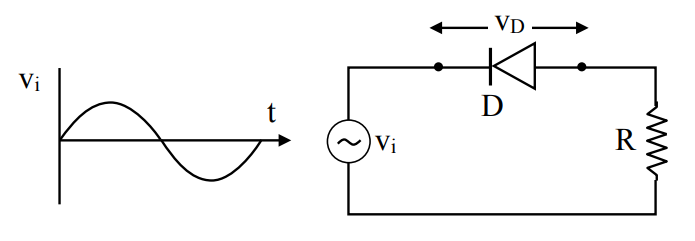 In the positive half cycle, the diode is reverse biased, so it is replaced by an open circuit and the full input voltage appears across the diode. In the negative half cycle, the diode is forward biased, so it acts like a wire and the input voltage appears across R (voltage across the diode is zero). So $v_D$ follows the input for the positive half cycle and is zero for the negative half cycle.
p-n junction diode - forward bias characteristics
-
Two statements are given below: I. When the forward bias voltage across a p-n junction diode increases above a certain threshold voltage, the diode current increases significantly. II. This current is called reverse saturation current. Choose the CORRECT answer from the options given below:Statement I is true: in forward bias, after the threshold (knee) voltage, the current increases significantly. Statement II is false: reverse saturation current is found in reverse bias, not in forward bias. So Statement I is true, but Statement II is false.
That is every question in Semiconductor Electronics: Materials, Devices and Simple Circuits for this filter.
Want a score?
Answers here are not saved. Practise as a test to be marked and see your progress.
Practise as a test