Looking for classes? Ksquare Career Institute, Bengaluru →

Physics
Current Electricity
130 questions from 38 papers, each with its answer.
- 130 questions
- 38 papers
- 7.37% of Physics
Wheatstone Bridge
-
The current passing through the battery in the given bridge circuit (balanced Wheatstone bridge with arms $5\,\Omega$, $2.5\,\Omega$, $3\,\Omega$, $1.5\,\Omega$, central resistor $6\,\Omega$, series resistors $1.5\,\Omega$, $5.5\,\Omega$, $\frac{1}{3}\,\Omega$ and battery $5\text{ V}$) is:
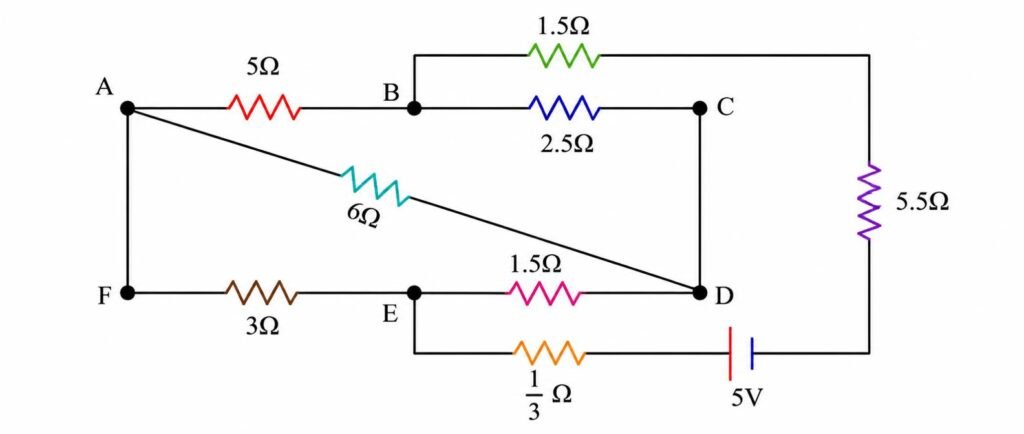
The bridge is balanced ($\frac{5}{2.5} = \frac{3}{1.5} = 2$), giving equivalent bridge resistance $\frac{8}{3}\,\Omega$. Total resistance is $10\,\Omega$, so $I = \frac{5\text{ V}}{10\,\Omega} = 0.5\text{ A}$.
The ratio of resistors is $\frac{R_{AB}}{R_{BC}} = \frac{5}{2.5} = 2$ and $\frac{R_{FE}}{R_{ED}} = \frac{3}{1.5} = 2$. Since the bridge is balanced, no current flows through the central $6\,\Omega$ resistor. Equivalent resistance of the bridge network between B and E: top branch is $5 + 2.5 = 7.5\,\Omega$... In the given diagram labeling, top branch $R_{top} = 5 + 3 = 8\,\Omega$ or $(5 + 2.5)$ and bottom $(3 + 1.5)$. Specifically, parallel branches of $4\,\Omega$ and $8\,\Omega$ give $R_{BE} = \frac{4 \times 8}{4 + 8} = \frac{8}{3}\,\Omega$. Total circuit resistance is $R_{total} = \frac{8}{3} + 1.5 + 5.5 + \frac{1}{3} = \frac{9}{3} + 7 = 3 + 7 = 10\,\Omega$. The battery current is $I = \frac{V}{R_{total}} = \frac{5\text{ V}}{10\,\Omega} = 0.5\text{ A}$.
Combination of Resistors
-
A wire of resistance $R$ is cut into 8 equal pieces. From these pieces two equivalent resistances are made by adding four of these together in parallel. Then these two sets are added in series. The net effective resistance of the combination is:
Each piece has resistance $R/8$. Four in parallel give $R_p = (R/8)/4 = R/32$. Two such sets in series give $R_{net} = R/32 + R/32 = R/16$.
Resistance of each piece: $r = R/8$. When 4 pieces are connected in parallel, the equivalent resistance of one set is $R_p = \frac{r}{4} = \frac{R/8}{4} = \frac{R}{32}$. When two such identical parallel sets are connected in series, the net resistance is $R_{net} = R_p + R_p = \frac{R}{32} + \frac{R}{32} = \frac{2R}{32} = \frac{R}{16}$.
Kirchhoff's Laws and Circuit Analysis
-
A constant voltage of $50\text{ V}$ is maintained between the points A and B of the circuit shown in the figure (bridge network with resistors $1\,\Omega$, $2\,\Omega$, $3\,\Omega$, $4\,\Omega$ and central vertical branch CD). The current through the branch CD of the circuit is:
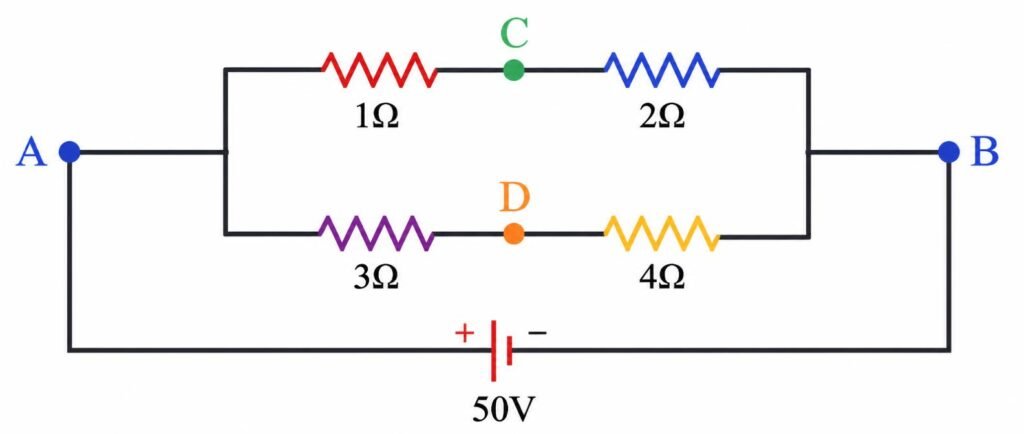
Applying Kirchhoff's loop laws for the circuit under $50\text{ V}$ bias yields current $i_{CD} = 2.0\text{ A}$.
Using Kirchhoff's loop equations: For loop ACDEA: $i_1(1) - i_2(3) = 0 \implies i_1 = 3i_2$. For loop CBFDC: $3 i_3 + 2 i_2 - i_1 = 0 \implies i_2 = 3 i_3$. For outer loop EDFGH with $50\text{ V}$ battery: $-3 i_2 - 4(i_2 + i_3) + 50 = 0 \implies 7 i_2 + 4 i_3 = 50$. Substituting $i_2 = 3 i_3$: $7(3 i_3) + 4 i_3 = 50 \implies 25 i_3 = 50 \implies i_3 = 2.0\text{ A}$. Thus, the current through branch CD is $2.0\text{ A}$.
That is every question in Current Electricity for this filter.
Want a score?
Answers here are not saved. Practise as a test to be marked and see your progress.
Practise as a test