Looking for classes? Ksquare Career Institute, Bengaluru →

Physics
Work, Energy and Power
71 questions from 36 papers, each with its answer.
- 71 questions
- 36 papers
- 4.02% of Physics
Work-Energy Theorem
-
The kinetic energies of two similar cars A and B are $100\text{ J}$ and $225\text{ J}$ respectively. On applying brakes, car A stops after $1000\text{ m}$ and car B stops after $1500\text{ m}$. If $F_A$ and $F_B$ are the forces applied by the brakes on cars A and B, respectively, then the ratio $F_A / F_B$ is:
From work-energy theorem, $F = \frac{KE}{s}$. Therefore, $F_A / F_B = \frac{100/1000}{225/1500} = \frac{0.10}{0.15} = \frac{2}{3}$.
According to the Work-Energy Theorem, work done by the braking force equals the change in kinetic energy: $W = F \cdot s = \Delta KE \implies F = \frac{KE}{s}$. For car A: $F_A = \frac{100\text{ J}}{1000\text{ m}} = 0.10\text{ N}$. For car B: $F_B = \frac{225\text{ J}}{1500\text{ m}} = 0.15\text{ N}$. The ratio is $\frac{F_A}{F_B} = \frac{0.10}{0.15} = \frac{2}{3}$.
Vertical Circular Motion
-
A bob of heavy mass $m$ is suspended by a light string of length $l$. The bob is given a horizontal velocity $v_0$ as shown in figure. If the string gets slack at some point P making an angle $\theta$ from the horizontal, the ratio of the speed $v$ of the bob at point P to its initial speed $v_0$ is:
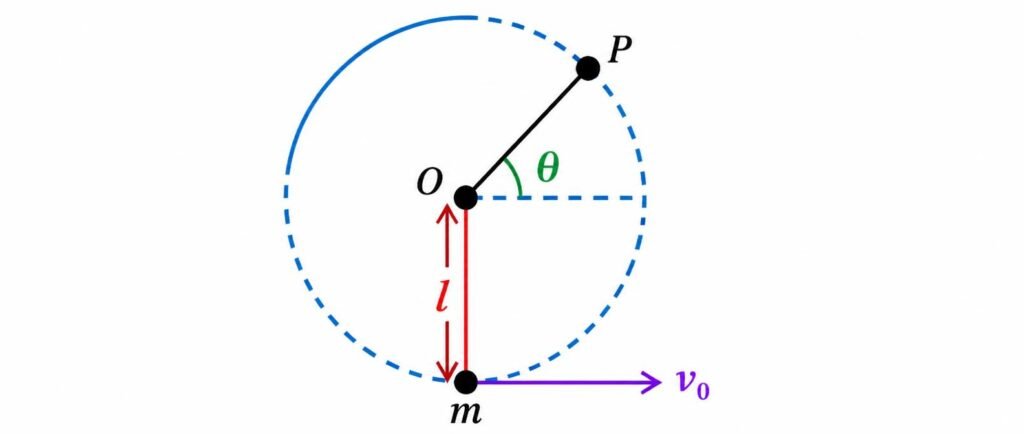
Setting tension $T = 0$ at slack point P gives $v = \sqrt{gl \sin\theta}$. Using conservation of energy gives $v_0 = \sqrt{gl(2 + 3\sin\theta)}$, so $v/v_0 = \sqrt{\frac{\sin\theta}{2 + 3\sin\theta}}$.
At point P where the string goes slack, tension $T = 0$. The radial component of gravity provides the necessary centripetal force: $mg \sin\theta = \frac{m v^2}{l} \implies v^2 = gl \sin\theta$. By conservation of mechanical energy between the lowest point and point P: $\frac{1}{2} m v_0^2 = \frac{1}{2} m v^2 + mg(l + l \sin\theta)$. Multiplying by $2/m$: $v_0^2 = v^2 + 2gl(1 + \sin\theta) = gl \sin\theta + 2gl + 2gl \sin\theta = gl(2 + 3\sin\theta)$. Thus, the ratio of speeds is $\frac{v}{v_0} = \sqrt{\frac{gl \sin\theta}{gl(2 + 3\sin\theta)}} = \left(\frac{\sin\theta}{2 + 3\sin\theta}\right)^{1/2}$.
That is every question in Work, Energy and Power for this filter.
Show all 71 questions Next: System of Particles and Rotational Motion
Want a score?
Answers here are not saved. Practise as a test to be marked and see your progress.
Practise as a test