Looking for classes? Ksquare Career Institute, Bengaluru →

Physics
Semiconductor Electronics
12 questions from 4 papers, each with its answer.
- 12 questions
- 4 papers
- 0.68% of Physics
Transistor – base current, collector current and current gain
-
In the circuit shown in the figure, the input voltage $V_i$ is 20 V, $V_{BE} = 0$ and $V_{CE} = 0$. The values of $I_B$, $I_C$ and $\beta$ are given by
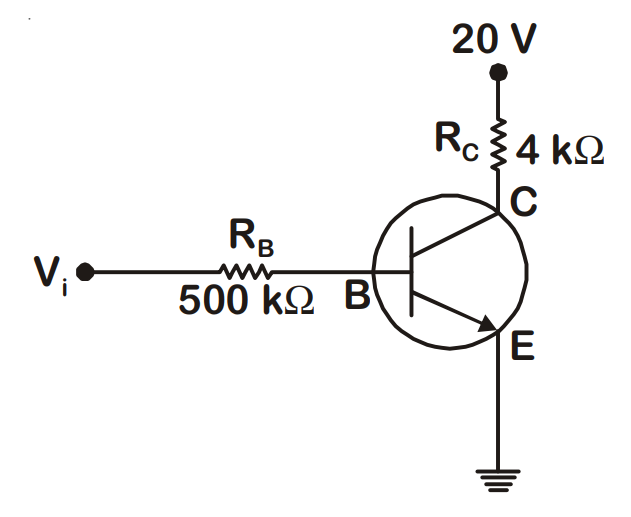
$I_C = 20/4k$, $I_B = 20/500k$, and $\beta = I_C/I_B$.
$V_{BE} = 0$, $V_{CE} = 0$, $V_b = 0$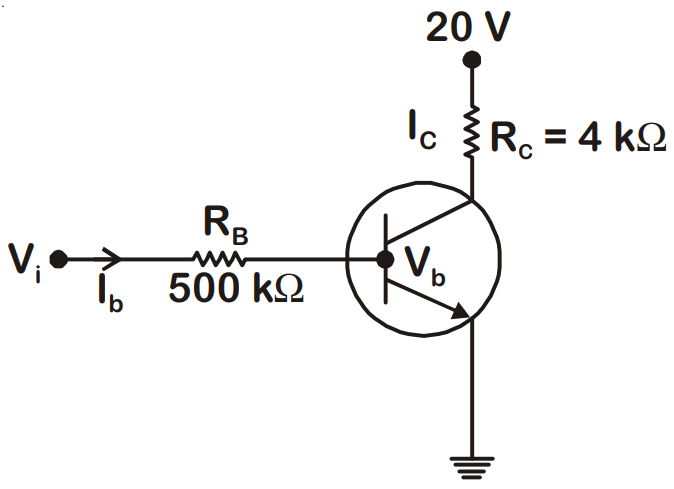
$I_C = \frac{(20 - 0)}{4\times10^{3}} = 5\times10^{-3}$ A $= 5$ mA
$V_i = V_{BE} + I_BR_B = 0 + I_BR_B$
$20 = I_B \times 500 \times 10^{3}$
$I_B = \frac{20}{500\times10^{3}} = 40\ \mu A$
$\beta = \frac{I_C}{I_B} = \frac{5\times10^{-3}}{40\times10^{-6}} = 125$
So $I_B = 40\ \mu A$, $I_C = 5$ mA and $\beta = 125$.
p-n junction diode – effect of temperature
-
In a p-n junction diode, change in temperature due to heating
Heating generates more electron-hole pairs, altering both forward and reverse behaviour.
Due to heating, the number of electron-hole pairs will increase, so the overall resistance of the diode will change. Due to this, both forward biasing and reverse biasing characteristics are changed. So heating affects the overall V–I characteristics of the p-n junction.
Logic gates – combination of gates
-
In the combination of the following gates the output Y can be written in terms of inputs A and B as
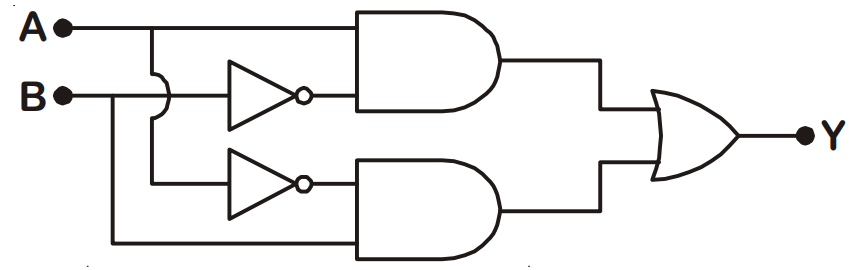
The circuit is an XOR gate: $Y = A\overline{B} + \overline{A}B$.
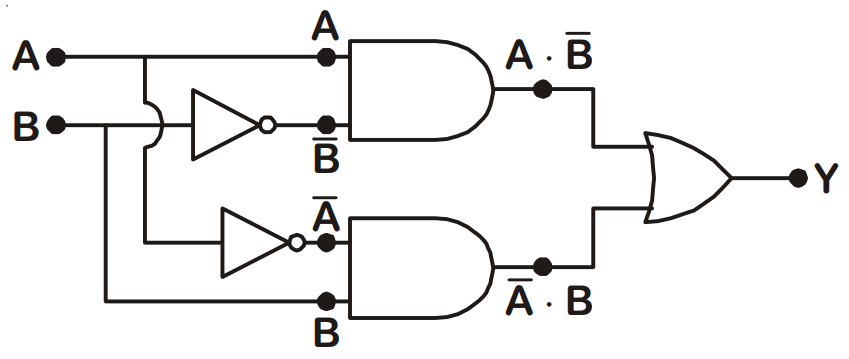
Upper AND gate receives A and $\overline{B}$: output $A\cdot\overline{B}$
Lower AND gate receives $\overline{A}$ and B: output $\overline{A}\cdot B$
OR gate: $Y = A\cdot\overline{B} + \overline{A}\cdot B$
That is every question in Semiconductor Electronics for this filter.
Want a score?
Answers here are not saved. Practise as a test to be marked and see your progress.
Practise as a test