Looking for classes? Ksquare Career Institute, Bengaluru →

Physics
Moving Charges and Magnetism
89 questions from 37 papers, each with its answer.
- 89 questions
- 37 papers
- 5.05% of Physics
Ampere's Circuital Law
-
A thick current carrying cable of radius $R$ carries current $I$ uniformly distributed across its cross-section. The variation of magnetic field $B(r)$ due to the cable with the distance $r$ from the axis of the cable is represented by:Inside the cable ($r R$): $B = \frac{\mu_0 I}{2\pi r} \propto \frac{1}{r}$ So B increases linearly up to r = R (maximum $\frac{\mu_0 I}{2\pi R}$ at the surface) and then decreases as $\frac{1}{r}$.
Lorentz Force
-
An infinitely long straight conductor carries a current of 5 A as shown. An electron is moving with a speed of $10^5\ m/s$ parallel to the conductor. The perpendicular distance between the electron and the conductor is 20 cm at an instant. Calculate the magnitude of the force experienced by the electron at that instant.
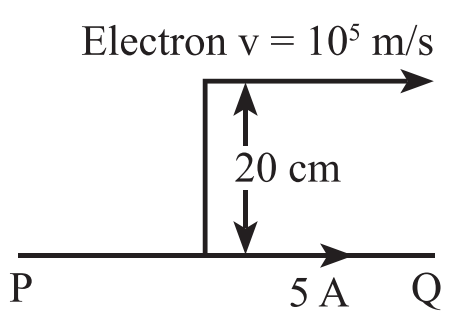
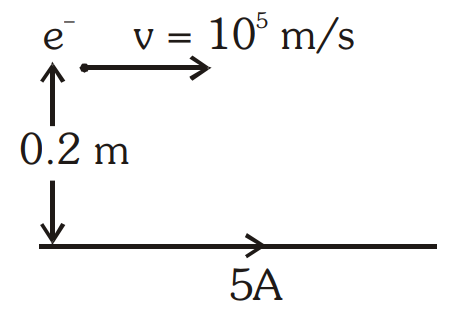 Field due to the wire at the electron: $B = \frac{\mu_0 i}{2\pi r}$
$F = evB = ev\left(\frac{\mu_0 i}{2\pi r}\right) = \frac{1.6 \times 10^{-19} \times 10^5 \times 2 \times 10^{-7} \times 5}{0.2}$
$F = 8 \times 10^{-20}$ N -
In the product $\vec{F}=q(\vec{v}\times\vec{B})=q\vec{v}\times(B\hat{i}+B\hat{j}+B_0\hat{k})$. For $q=1$ and $\vec{v}=2\hat{i}+4\hat{j}+6\hat{k}$ and $\vec{F}=4\hat{i}-20\hat{j}+12\hat{k}$. What will be the complete expression for $\vec{B}$?$\vec{F} = q(\vec{v} \times \vec{B})$ with q = 1: $4\hat{i} - 20\hat{j} + 12\hat{k} = \begin{vmatrix} \hat{i} & \hat{j} & \hat{k} \\ 2 & 4 & 6 \\ B & B & B_0 \end{vmatrix}$ Comparing components: $4 = 4B_0 - 6B$, $-20 = -2B_0 + 6B$, $12 = 2B - 4B$ Solving: B = –6, $B_0 = -8$ $\vec{B} = -6\hat{i} - 6\hat{j} - 8\hat{k}$
That is every question in Moving Charges and Magnetism for this filter.
Want a score?
Answers here are not saved. Practise as a test to be marked and see your progress.
Practise as a test