Looking for classes? Ksquare Career Institute, Bengaluru →

Physics
System of Particles and Rotational Motion
100 questions from 38 papers, each with its answer.
- 100 questions
- 38 papers
- 5.67% of Physics
Radius of gyration and parallel axis theorem
-
The radius of gyration of a solid sphere of mass 5 kg about XY is 5 m as shown in figure. The radius of the sphere is $\dfrac{5x}{\sqrt{7}}$ m, then the value of x is:
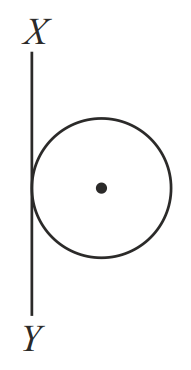 For a solid sphere about a tangent axis: $I_{XY}=I_g+MR^2=\dfrac{2}{5}MR^2+MR^2=\dfrac{7}{5}MR^2=7R^2$ (since $M=5$ kg). Also $I_{XY}=MK^2=5\times5^2=125$. So $7R^2=125\Rightarrow R=\sqrt{\dfrac{125}{7}}=\dfrac{5\sqrt5}{\sqrt7}$, matching $\dfrac{5x}{\sqrt7}$ gives $x=\sqrt5$.
Uniform angular velocity
-
Let $\omega_1,\omega_2$ and $\omega_3$ be the angular speed of the second hand, minute hand and hour hand of a smoothly running analog clock, respectively. If $x_1,x_2$ and $x_3$ are their respective angular distances in 1 minute then the factor which remains constant (k) isEach hand moves with constant angular speed, so the angular distance covered in 1 minute is $x=\omega\times t$ where $t=60$ s is the same for all hands. Hence $\dfrac{\omega_1}{x_1}=\dfrac{\omega_2}{x_2}=\dfrac{\omega_3}{x_3}=\dfrac{1}{t}=k$.
That is every question in System of Particles and Rotational Motion for this filter.
Want a score?
Answers here are not saved. Practise as a test to be marked and see your progress.
Practise as a test