Looking for classes? Ksquare Career Institute, Bengaluru →

Physics
System of Particles and Rotational Motion
100 questions from 38 papers, each with its answer.
- 100 questions
- 38 papers
- 5.67% of Physics
Linear momentum of a system of particles
-
A frictionless circular wire of unit radius is fixed on the horizontal plane. Two point particles of unit mass start moving simultaneously from point A ($\theta=\frac{\pi}{2}$) with identical uniform angular speeds in opposite directions, and meet again at point B ($\theta=-\frac{\pi}{2}$). During this time, which of the following figures schematically represent the magnitude of the total linear momentum P of the system, as a function of $\theta$?
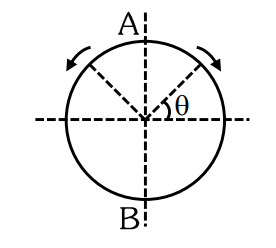 Taking $\theta$ as the angle of each particle from the horizontal: $\vec{P}_1+\vec{P}_2=(mv\sin\theta\hat{i}-mv\cos\theta\hat{j})+(-mv\sin\theta\hat{i}-mv\cos\theta\hat{j})$, so $P_{total}=|\vec{P}_1+\vec{P}_2|=2mv\cos\theta$. At $\theta=\pm\frac{\pi}{2}$, $P_{total}=0$; at $\theta=0$, $P_{total}=2mv$ (maximum). The graph is a single hump between $\frac{\pi}{2}$ and $-\frac{\pi}{2}$.
Moment of inertia - parallel axis theorem
-
A solid sphere A of radius R and mass M is attached at a point to a smaller solid sphere B of radius r < R and mass m < M. Assume that the line joining their centres lies along the horizontal. The moment of inertia of the system calculated about a vertical axis passing through the centre of A is $I_A$ and that calculated about a vertical axis passing through the centre of B is $I_B$. The difference $I_A-I_B$ is:
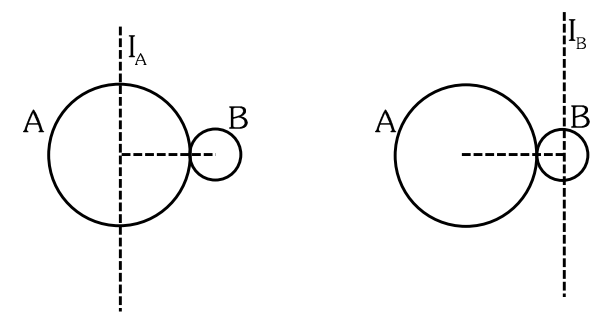 $I_A=\frac{2}{5}MR^2+\frac{2}{5}mr^2+m(R+r)^2$ and $I_B=\frac{2}{5}mr^2+\frac{2}{5}MR^2+M(R+r)^2$. $I_A-I_B=m(R+r)^2-M(R+r)^2=(m-M)(R+r)^2$.
Angular momentum about different points
-
A thin horizontal disc is rotating about a vertical axis passing through its fixed centre O. Its angular momentum is $L_A$ and $L_B$ computed about points A and B, respectively, with OB = 2 × OA. The value of $\frac{L_A}{L_B}$ is:
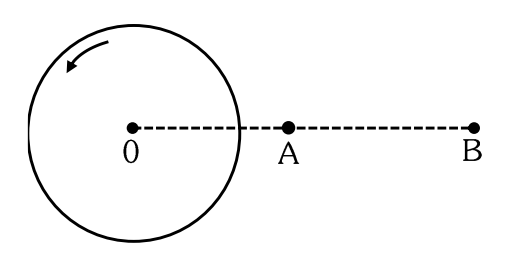 For a body in pure rotation, the angular momentum is the same about every point: $L=I\omega$. So $L_A=\frac{MR^2}{2}\omega$ and $L_B=\frac{MR^2}{2}\omega$, giving $\frac{L_A}{L_B}=1$.
That is every question in System of Particles and Rotational Motion for this filter.
Want a score?
Answers here are not saved. Practise as a test to be marked and see your progress.
Practise as a test