Looking for classes? Ksquare Career Institute, Bengaluru →

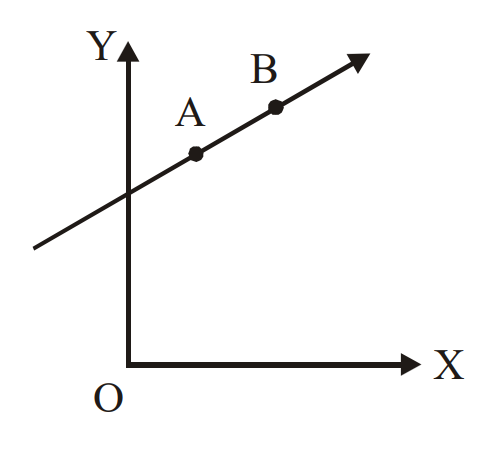
A particle of mass $m$ moves in the XY plane with a velocity $v$ along the straight line AB. If the angular momentum of the particle with respect to origin O is $L_A$ when it is at A and $L_B$ when it is at B, then
A
$L_A = L_B$
B
the relationship between $L_A$ and $L_B$ depends upon the slope of the line AB
C
$L_A \lt L_B$
D
$L_A \gt L_B$
Detailed Solution
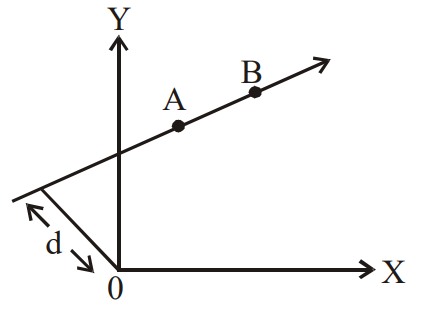
Angular momentum = linear momentum $\times$ perpendicular distance of the line of action of the linear momentum from the origin.
Let $d$ be the perpendicular distance of the line AB from the origin O.
$L_A = p_A \times d$ and $L_B = p_B \times d$
The particle moves with the same velocity $v$ along the same straight line, so the linear momenta are equal: $p_A = p_B = mv$.
The perpendicular distance $d$ of the line of motion from O is the same for every point of the line.
Therefore $L_A = L_B = mvd$.
The angular momentum of a particle moving with constant velocity is constant about any fixed point, because no torque acts on it.