Looking for classes? Ksquare Career Institute, Bengaluru →

A small mass attached to a string rotates on a frictionless table top as shown. If the tension in the string is increased by pulling the string causing the radius of the circular motion to decrease by a factor of 2, the kinetic energy of the mass will
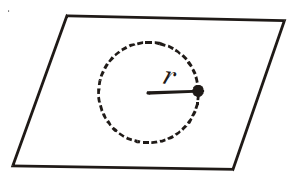
A
Increase by a factor of 4
B
Decrease by a factor of 2
C
Remain constant
D
Increase by a factor of 2
Detailed Solution
The tension acts along the string towards the centre, so its torque about the centre is zero and the angular momentum of the mass is conserved.
$mvr = mv'r'$ with $r' = \frac{r}{2}$
$mvr = mv'\frac{r}{2}$, so $v' = 2v$
Initial kinetic energy: $KE = \frac{1}{2}mv^2$
Final kinetic energy: $KE' = \frac{1}{2}m(2v)^2 = 4\times\frac{1}{2}mv^2 = 4KE$
So the kinetic energy increases by a factor of 4 (the extra energy comes from the work done in pulling the string).
$mvr = mv'r'$ with $r' = \frac{r}{2}$
$mvr = mv'\frac{r}{2}$, so $v' = 2v$
Initial kinetic energy: $KE = \frac{1}{2}mv^2$
Final kinetic energy: $KE' = \frac{1}{2}m(2v)^2 = 4\times\frac{1}{2}mv^2 = 4KE$
So the kinetic energy increases by a factor of 4 (the extra energy comes from the work done in pulling the string).