Looking for classes? Ksquare Career Institute, Bengaluru →

System of Particles and Rotational Motion
Conservation of Angular Momentum
11 questions from 11 papers, each with its answer.
- questions
- 11
- papers
- 11
- years asked, 2017–2026
- 2 of 10
- of System of Particles and Rotational Motion
- 11%
Appears in
Concepts tested
- Change in moment of inertia 2
- Angular momentum and kinetic energy
- Angular Momentum Conservation
- Angular momentum conservation for coaxial discs
- Central force angular momentum
- Change in angular velocity when mass is added
- conservation-angular-momentum
- Loss of rotational kinetic energy
- Man walking on a platform
- No external torque, angular momentum conserved
All Questions
2025 1 question
-
The Sun rotates around its centre once in $27\text{ days}$. What will be the period of revolution if the Sun were to expand to twice its present radius without any external influence? Assume the Sun to be a sphere of uniform density.
Conservation of angular momentum gives $I_1 \omega_1 = I_2 \omega_2$. Since $I \propto R^2$, $T_2 = T_1 (R_2/R_1)^2 = 27 \times 4 = 108\text{ days}$.
In the absence of external torque, angular momentum is conserved: $L = I_1 \omega_1 = I_2 \omega_2$. For a uniform sphere, $I = \frac{2}{5} M R^2$. When the radius doubles ($R_2 = 2 R_1$), the moment of inertia becomes $I_2 = \frac{2}{5} M (2R_1)^2 = 4 I_1$. Since $\omega = \frac{2\pi}{T}$, we have $I_1 \left(\frac{2\pi}{T_1}\right) = (4 I_1) \left(\frac{2\pi}{T_2}\right) \implies T_2 = 4 T_1 = 4 \times 27\text{ days} = 108\text{ days}$.
2018 1 question
-
A solid sphere is rotating freely about its symmetry axis in free space. The radius of the sphere is increased keeping its mass same. Which of the following physical quantities would remain constant for the sphere?
No external torque, so angular momentum is conserved.
$\tau_{ext} = 0$ So, $\frac{dL}{dt} = 0$, i.e. L = constant So angular momentum remains constant.
2015 AIPMT-I 1 question
-
A mass m moves in a circle on a smooth horizontal plane with velocity $v_0$ at a radius $R_0$. The mass is attached to a string which passes through a smooth hole in the plane as shown.
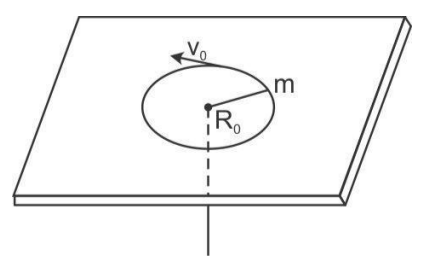
The tension in the string is increased gradually and finally m moves in a circle of radius $\frac{R_0}{2}$. The final value of the kinetic energy isThe tension is a central force, so angular momentum about the hole is conserved.
$mv_0R_0 = mv\frac{R_0}{2} \Rightarrow v = 2v_0$
$KE_f = \frac{1}{2}m(2v_0)^2 = 2mv_0^2$
2012 AIPMT-MAINS 1 question
-
A circular platform is mounted on a frictionless vertical axle. Its radius R = 2 m and its moment of inertia about the axle is 200 kg $m^2$. It is initially at rest. A 50 kg man stands on the edge of the platform and begins to walk along the edge at the speed of 1 $ms^{-1}$ relative to the ground. Time taken by the man to complete one revolution isAngular velocity of the man relative to the ground: $\omega_m = \frac{v}{R} = \frac{1}{2}$ rad/s
Moment of inertia of the man about the axle: $I_m = mR^2 = 50\times(2)^2 = 200$ kg $m^2$
The system starts from rest and there is no external torque, so the platform turns the opposite way: $I_p\omega_p = I_m\omega_m$
$200\times\omega_p = 200\times\frac{1}{2} \Rightarrow \omega_p = \frac{1}{2}$ rad/s (opposite direction)
Angular velocity of the man relative to the platform: $\omega = \omega_m - (-\omega_p) = \frac{1}{2} + \frac{1}{2} = 1$ rad/s
Time for one revolution: $T = \frac{2\pi}{\omega} = 2\pi$ s
2011 AIPMT-MAINS 1 question
-
A small mass attached to a string rotates on a frictionless table top as shown. If the tension in the string is increased by pulling the string causing the radius of the circular motion to decrease by a factor of 2, the kinetic energy of the mass will
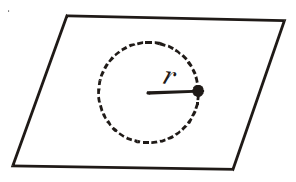 The tension acts along the string towards the centre, so its torque about the centre is zero and the angular momentum of the mass is conserved.
$mvr = mv'r'$ with $r' = \frac{r}{2}$
$mvr = mv'\frac{r}{2}$, so $v' = 2v$
Initial kinetic energy: $KE = \frac{1}{2}mv^2$
Final kinetic energy: $KE' = \frac{1}{2}m(2v)^2 = 4\times\frac{1}{2}mv^2 = 4KE$
So the kinetic energy increases by a factor of 4 (the extra energy comes from the work done in pulling the string).
2010 AIPMT-MAINS 1 question
-
A thin circular ring of mass M and radius r is rotating about its axis with constant angular velocity $\omega$. Two objects each of mass m are attached gently to the opposite ends of a diameter of the ring. The ring now rotates with angular velocity given byThe objects are attached gently, so no external torque acts; angular momentum is conserved: $I_1\omega_1 = I_2\omega_2$
Initial moment of inertia of the ring: $I_1 = Mr^2$
After attaching the two masses at distance r from the axis: $I_2 = Mr^2 + 2mr^2 = (M + 2m)r^2$
$Mr^2\omega = (M + 2m)r^2\omega'$
$\omega' = \frac{M\omega}{M + 2m}$
2010 AIPMT-PRE 1 question
-
A circular disk of moment of inertia $I_t$ is rotating in a horizontal plane, about its symmetry axis, with a constant angular speed $\omega_i$. Another disk of moment of inertia $I_b$ is dropped coaxially onto the rotating disk. Initially the second disk has zero angular speed. Eventually both the disks rotate with a constant angular speed $\omega_f$. The energy lost by the initially rotating disc to friction isNo external torque acts on the two-disk system, so angular momentum is conserved: $I_t\omega_i = (I_t + I_b)\omega_f$
$\omega_f = \frac{I_t\omega_i}{I_t + I_b}$
Initial kinetic energy: $K_i = \frac{1}{2}I_t\omega_i^2$
Final kinetic energy: $K_f = \frac{1}{2}(I_t + I_b)\omega_f^2 = \frac{1}{2}\frac{I_t^2\omega_i^2}{(I_t + I_b)}$
Energy lost: $\Delta E = K_i - K_f = \frac{1}{2}I_t\omega_i^2\left[1 - \frac{I_t}{I_t + I_b}\right]$
$\Delta E = \frac{1}{2}\frac{I_bI_t}{(I_t + I_b)}\omega_i^2$
2009 AIPMT 1 question
-
A thin circular ring of mass M and radius R is rotating in a horizontal plane about an axis vertical to its plane with a constant angular velocity $\omega$. If two objects each of mass m be attached gently to the opposite ends of a diameter of the ring, the ring will then rotate with an angular velocityThe objects are attached gently, so no external torque acts and angular momentum is conserved: $I_1\omega_1 = I_2\omega_2$
Initial moment of inertia of the ring: $I_1 = MR^2$
After attaching two masses m at distance R from the axis: $I_2 = MR^2 + 2mR^2 = (M + 2m)R^2$
$MR^2\omega = (M + 2m)R^2\omega'$
$\omega' = \frac{\omega M}{M + 2m}$
2004 AIPMT 1 question
-
A round disc of moment of inertia $I_2$ about its axis perpendicular to its plane and passing through its centre is placed over another disc of moment of inertia $I_1$ rotating with an angular velocity $\omega$ about the same axis. The final angular velocity of the combination of discs is :-No external torque acts on the system of two discs (the friction between them is internal). So angular momentum is conserved.
Initial angular momentum $= I_1\omega$ (the second disc is initially at rest).
Final angular momentum $= (I_1 + I_2)\omega'$, since both discs finally rotate together.
From conservation of angular momentum: $I_1\omega = (I_1 + I_2)\omega'$
$\Rightarrow \omega' = \dfrac{I_1\omega}{I_1 + I_2}$
2003 AIPMT 1 question
-
A thin circular ring of mass M and radius 'r' is rotating about its axis with a constant angular velocity $\omega$. Four objects each of mass m, are kept gently to the opposite ends of two perpendicular diameters of the ring. The angular velocity of the ring will be -The objects are placed gently, so no external torque acts about the axis. Use the law of conservation of angular momentum.
Initial moment of inertia of the ring about its axis: $I_1 = Mr^2$
Each of the four objects is at distance r from the axis, so final moment of inertia: $I_2 = Mr^2 + 4mr^2$
$I_1\omega = I_2\omega'$
$Mr^2\omega = (Mr^2 + 4mr^2)\omega'$
$\Rightarrow \omega' = \dfrac{M\omega}{M + 4m}$
The angular velocity decreases because the moment of inertia has increased.
2002 AIPMT 1 question
-
A disc is rotating with angular speed $\omega$. If a child sits on it, what is conserved : -When the child sits on the disc, the forces between the child and the disc are internal to the system. No external torque acts about the axis of rotation.
So the angular momentum $L = I\omega$ is conserved. The moment of inertia increases, so the angular speed decreases: $I_1\omega_1 = I_2\omega_2$.
Kinetic energy $\dfrac{L^2}{2I}$ decreases, because some energy is lost as the child comes to rotate with the disc (friction).
So angular momentum is conserved.