Looking for classes? Ksquare Career Institute, Bengaluru →

System of Particles and Rotational Motion
Moment of Inertia
8 questions from 8 papers, each with its answer.
- questions
- 8
- papers
- 8
- years asked, 2017–2026
- 1 of 10
- of System of Particles and Rotational Motion
- 8%
Appears in
Concepts tested
- Parallel axis theorem 2
- Distribution of mass and moment of inertia
- Minimum MI about centre of mass
- Moment of inertia of a bent rod
- Moment of inertia of a disc with a hole
- moment of inertia of a ring with a sector removed
- Parallel axis theorem for shells
All Questions
2021 1 question
-
From a circular ring of mass $M$ and radius $R$ an arc corresponding to a $90^\circ$ sector is removed. The moment of inertia of the remaining part of the ring about an axis passing through the centre of the ring and perpendicular to the plane of the ring is $K$ times $MR^2$. Then the value of $K$ is:Removing a $90^\circ$ arc leaves $\frac{3}{4}$ of the ring: $M_{remain} = \frac{3}{4}M$ All of the remaining mass is at distance R from the axis: $I = M_{remain}R^2 = \frac{3}{4}MR^2 \Rightarrow K = \frac{3}{4}$
2015 AIPMT-I 1 question
-
Three identical spherical shells, each of mass m and radius r are placed as shown in figure. Consider an axis XX' which is touching two shells and passing through diameter of third shell. Moment of inertia of the system consisting of these three spherical shells about XX' axis is
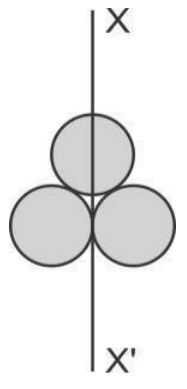 About a diameter of a thin spherical shell: $I = \frac{2}{3}mr^2$, so $I_1 = \frac{2}{3}mr^2$.
About a tangent (parallel axis theorem): $I = \frac{2}{3}mr^2 + mr^2 = \frac{5}{3}mr^2$, so $I_2 = I_3 = \frac{5}{3}mr^2$.
$I_{XX'} = \frac{2}{3}mr^2 + \frac{5}{3}mr^2 + \frac{5}{3}mr^2 = 4mr^2$
2015 AIPMT-II 1 question
-
Point masses $m_1$ and $m_2$ are placed at the opposite ends of a rigid rod of length L, and negligible mass. The rod is to be set rotating about an axis perpendicular to it. The position of point P on this rod through which the axis should pass so that the work required to set the rod rotating with angular velocity $\omega_0$ is minimum, is given by:
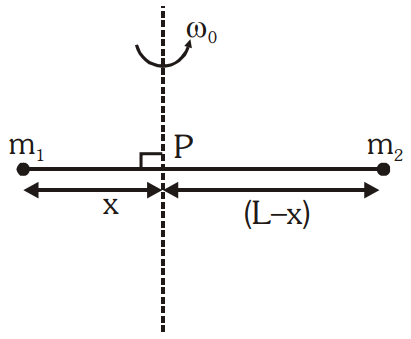 Work required $= \frac{1}{2}I\omega_0^2$, which is minimum when I is minimum, i.e. when the axis passes through the centre of mass.
$m_1x = m_2(L - x)$
$x = \frac{m_2L}{m_1 + m_2}$
2012 AIPMT-MAINS 1 question
-
The moment of inertia of a uniform circular disc is maximum about an axis perpendicular to the disc and passing through
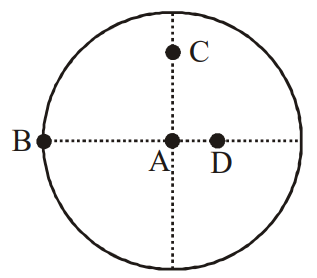 Parallel axis theorem: $I = I_{cm} + Md^2$, where d is the distance of the axis from the centre.
I is maximum for the point farthest from the centre.
B lies on the rim (d = R), while A, C and D are closer to the centre, so the moment of inertia is maximum about the axis through B.
2010 AIPMT-MAINS 1 question
-
From a circular disc of radius R and mass 9M, a small disc of mass M and radius $\frac{R}{3}$ is removed concentrically. The moment of inertia of the remaining disc about an axis perpendicular to the plane of the disc and passing through its centre isMoment of inertia of a disc about its axis: $I = \frac{1}{2}(\text{mass})(\text{radius})^2$
Complete disc: $I_1 = \frac{1}{2}(9M)R^2 = \frac{9MR^2}{2}$
Removed disc (same axis, since it is concentric): $I_2 = \frac{1}{2}M\left(\frac{R}{3}\right)^2 = \frac{MR^2}{18}$
Remaining disc: $I = I_1 - I_2 = \frac{9MR^2}{2} - \frac{MR^2}{18} = \frac{81MR^2 - MR^2}{18}$
$I = \frac{80MR^2}{18} = \frac{40}{9}MR^2$
2009 AIPMT 1 question
-
Four identical thin rods each of mass M and length l, form a square frame. Moment of inertia of this frame about an axis through the centre of the square and perpendicular to its plane isMoment of inertia of one rod about an axis through its own centre and perpendicular to its length: $I_{cm} = \frac{Ml^2}{12}$
The centre of the square is at a perpendicular distance $\frac{l}{2}$ from the centre of each rod.
By the parallel axis theorem, for one rod about the axis through the centre of the square: $I_1 = \frac{Ml^2}{12} + M\left(\frac{l}{2}\right)^2 = \frac{Ml^2}{12} + \frac{Ml^2}{4} = \frac{Ml^2}{3}$
For the four rods: $I = 4\times\frac{Ml^2}{3}$
$I = \frac{4}{3}Ml^2$
2008 AIPMT 1 question
-
A thin rod of length $L$ and mass $M$ is bent at its midpoint into two halves so that the angle between them is $90^\circ$. The moment of inertia of the bent rod about an axis passing through the bending point and perpendicular to the plane defined by the two halves of the rod is -After bending, each half is a thin rod of mass $\dfrac{M}{2}$ and length $\dfrac{L}{2}$.
The axis passes through the bending point, which is one end of each half, and is perpendicular to both halves.
Moment of inertia of a thin rod of mass $m$ and length $l$ about a perpendicular axis through its end $= \dfrac{ml^2}{3}$
For one half: $I_1 = \dfrac{(M/2)(L/2)^2}{3} = \dfrac{ML^2}{24}$
Moment of inertia of the system: $I = \dfrac{(M/2)(L/2)^2}{3} + \dfrac{(M/2)(L/2)^2}{3}$
$I = \dfrac{ML^2}{24} + \dfrac{ML^2}{24}$
$I = \dfrac{ML^2}{12}$
The angle between the halves does not matter, because every element stays at the same distance from the axis.
2002 AIPMT 1 question
-
A circular disc is to be made by using iron and aluminium so that it acquires maximum moment of inertia about geometrical axis. It is possible with : -Moment of inertia: $I = \sum mr^2$. Mass placed farther from the axis contributes much more, since it is multiplied by $r^2$.
The density of iron (about 7.8 g/cm$^3$) is more than that of aluminium (about 2.7 g/cm$^3$).
So to make I maximum, the heavier material (iron) should be placed far from the axis, i.e. on the outer ring, and the lighter aluminium in the interior.
Putting iron sheets on the two flat faces does not move mass farther from the axis.
So the moment of inertia is maximum with aluminium at the interior and iron surrounding it.