Looking for classes? Ksquare Career Institute, Bengaluru →

System of Particles and Rotational Motion
Centre of Mass
7 questions from 7 papers, each with its answer.
- questions
- 7
- papers
- 7
- years asked, 2017–2026
- 2 of 10
- of System of Particles and Rotational Motion
- 7%
Appears in
Concepts tested
- centre of mass of two particles 2
- Centre of mass of point masses
- Keeping centre of mass fixed
- Motion of centre of mass
- No external force
- Position of centre of mass
All Questions
2022 1 question
-
Two objects of mass 10 kg and 20 kg respectively are connected to the two ends of a rigid rod of length 10 m with negligible mass. The distance of the centre of mass of the system from the 10 kg mass is :Taking the 10 kg mass at the origin and the 20 kg mass at 10 m: $X_{CM} = \frac{10 \times 0 + 20 \times 10}{10 + 20} = \frac{200}{30} = \frac{20}{3}$ m
2020 1 question
-
Two particles of mass 5 kg and 10 kg respectively are attached to the two ends of a rigid rod of length 1 m with negligible mass. The centre of mass of the system from the 5 kg particle is nearly at a distance of:Taking the 5 kg mass at the origin and the 10 kg mass at 100 cm: $x_{cm} = \frac{5 \times 0 + 10 \times 100}{5 + 10} = \frac{200}{3} = 66.66$ cm ≈ 67 cm
2012 AIPMT-MAINS 1 question
-
Three masses are placed on the x-axis: 300 g at origin, 500 g at x = 40 cm and 400 g at x = 70 cm. The distance of the centre of mass from the origin is$x_{cm} = \frac{m_1x_1 + m_2x_2 + m_3x_3}{m_1 + m_2 + m_3}$
$= \frac{300\times0 + 500\times40 + 400\times70}{300 + 500 + 400}$
$= \frac{20000 + 28000}{1200} = \frac{48000}{1200} = 40$ cm
2012 AIPMT-PRE 1 question
-
Two persons of masses 55 kg and 65 kg respectively, are at the opposite ends of a boat. The length of the boat is 3.0 m and weighs 100 kg. The 55 kg man walks up to the 65 kg man and sits with him. If the boat is in still water the centre of mass of the system shifts byThe men and the boat form one system; the forces between them are internal.
There is no external horizontal force on the system and it was initially at rest.
So the centre of mass of the system does not move: the shift is zero (the boat moves the other way to keep it fixed).
2010 AIPMT-PRE 1 question
-
Two particles which are initially at rest, move towards each other under the action of their internal attraction. If their speeds are v and 2v at any instant, then the speed of centre of mass of the system will beThe particles attract each other; these are internal forces of the system. There is no external force.
$\vec{F}_{ext} = M\vec{a}_{cm} = 0$, so the velocity of the centre of mass remains constant.
Initially both particles are at rest, so the velocity of the centre of mass is zero.
It therefore remains zero at every later instant, whatever the individual speeds (v and 2v) are.
Speed of the centre of mass = zero
2009 AIPMT 1 question
-
Two bodies of mass 1 kg and 3 kg have position vectors $\hat{i} + 2\hat{j} + \hat{k}$ and $-3\hat{i} - 2\hat{j} + \hat{k}$, respectively. The centre of mass of this system has a position vector$\vec{r}_{cm} = \frac{m_1\vec{r}_1 + m_2\vec{r}_2}{m_1 + m_2}$
$m_1\vec{r}_1 = 1(\hat{i} + 2\hat{j} + \hat{k}) = \hat{i} + 2\hat{j} + \hat{k}$
$m_2\vec{r}_2 = 3(-3\hat{i} - 2\hat{j} + \hat{k}) = -9\hat{i} - 6\hat{j} + 3\hat{k}$
Sum $= -8\hat{i} - 4\hat{j} + 4\hat{k}$
$\vec{r}_{cm} = \frac{-8\hat{i} - 4\hat{j} + 4\hat{k}}{4}$
$\vec{r}_{cm} = -2\hat{i} - \hat{j} + \hat{k}$
2004 AIPMT 1 question
-
Consider a system of two particles having masses $m_1$ and $m_2$. If the particle of mass $m_1$ is pushed towards the mass centre of particles through a distance 'd', by what distance would the particle of mass $m_2$ move so as to keep the mass centre of particles at the original position :-
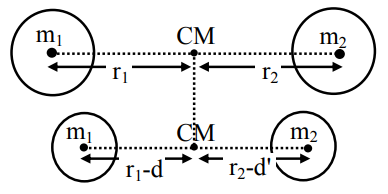
Let $r_1$ and $r_2$ be the distances of $m_1$ and $m_2$ from the centre of mass (CM). Taking moments about the CM:
$m_1r_1 = m_2r_2$ ...(1)
$m_1$ is moved a distance d towards the CM. For the CM to stay at the same place, $m_2$ must also move towards the CM by some distance $d'$:
$m_1(r_1 - d) = m_2(r_2 - d')$ ...(2)
Subtracting (2) from (1): $m_1 d = m_2 d'$
$\Rightarrow d' = \dfrac{m_1}{m_2}d$
So the particle of mass $m_2$ must move a distance $\dfrac{m_1}{m_2}d$ towards the centre of mass.