2004 AIPMT System of Particles and Rotational MotionCentre of Mass Easy Question 7 of 7 in Centre of Mass

Consider a system of two particles having masses $m_1$ and $m_2$. If the particle of mass $m_1$ is pushed towards the mass centre of particles through a distance 'd', by what distance would the particle of mass $m_2$ move so as to keep the mass centre of particles at the original position :-

A $\dfrac{m_1}{m_2}d$
B $d$
C $\dfrac{m_2}{m_1}d$
D $\dfrac{m_1}{m_1 + m_2}d$

The answer is A.
Solution


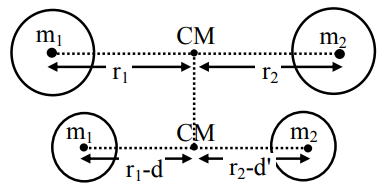
Let $r_1$ and $r_2$ be the distances of $m_1$ and $m_2$ from the centre of mass (CM). Taking moments about the CM:
$m_1r_1 = m_2r_2$ ...(1)
$m_1$ is moved a distance d towards the CM. For the CM to stay at the same place, $m_2$ must also move towards the CM by some distance $d'$:
$m_1(r_1 - d) = m_2(r_2 - d')$ ...(2)
Subtracting (2) from (1): $m_1 d = m_2 d'$
$\Rightarrow d' = \dfrac{m_1}{m_2}d$
So the particle of mass $m_2$ must move a distance $\dfrac{m_1}{m_2}d$ towards the centre of mass.

Concept Keeping centre of mass fixed

Centre of Mass in past papers

7 questions from this chapter have appeared across 6 exam years.
