Looking for classes? Ksquare Career Institute, Bengaluru →

System of Particles and Rotational Motion
Rolling Motion
8 questions from 8 papers, each with its answer.
- questions
- 8
- papers
- 8
- years asked, 2017–2026
- 1 of 10
- of System of Particles and Rotational Motion
- 8%
Appears in
Concepts tested
- Energy of a rolling body 2
- Acceleration of a rolling body
- Role of static friction in rolling
- Rolling vs sliding on an incline
- Speed of a rolling body down an incline
- Velocities of points on a rolling body
- Velocity of points on a rolling wheel
All Questions
2024 1 question
-
A wheel of a bullock cart is rolling on a level road as shown in the figure below. If its linear speed is $v$ in the direction shown, which one of the following options is correct ($P$ and $Q$ are any highest and lowest points on the wheel respectively)?
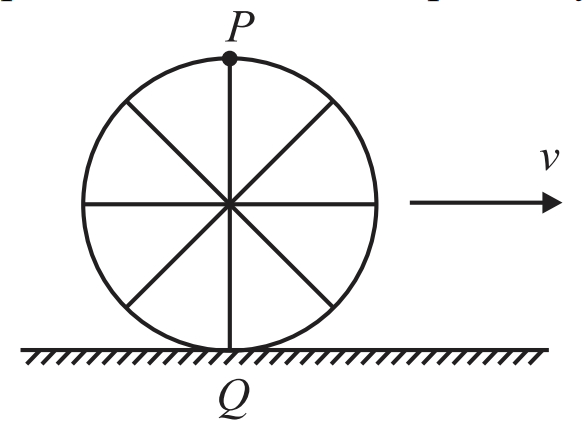 [add image: rolling wheel with top point P moving at 2v and contact point Q at rest] For pure rolling, the lowest point Q (point of contact) is instantaneously at rest: $v_Q = v - v = 0$. The highest point P moves with speed $v_P = v + v = 2v$. So point P moves faster than point Q.
2014 AIPMT 1 question
-
The ratio of the accelerations for a solid sphere (mass 'm' and radius 'R') rolling down an incline of angle '$\theta$' without slipping and slipping down the incline without rolling is:Rolling without slipping: $a_1 = \frac{g\sin\theta}{1 + \frac{K^2}{R^2}}$
Slipping without rolling: $a_2 = g\sin\theta$
$\frac{a_1}{a_2} = \frac{1}{1 + \frac{K^2}{R^2}} = \frac{1}{1 + \frac{2}{5}} = \frac{5}{7}$
2013 NEET 1 question
-
A small object of uniform density rolls up a curved surface with an initial velocity 'v'. It reaches upto a maximum height of $\frac{3v^2}{4g}$ with respect to the initial position. The object isConservation of mechanical energy: $\frac{1}{2}mv^2\left(1 + \frac{K^2}{R^2}\right) = mgh$
$\frac{1}{2}mv^2\left(1 + \frac{K^2}{R^2}\right) = mg\left(\frac{3v^2}{4g}\right) \Rightarrow \frac{K^2}{R^2} = \frac{1}{2}$
So the object is a disc.
2012 AIPMT-PRE 1 question
-
A solid cylinder of mass 3 kg is rolling on a horizontal surface with velocity 4 $ms^{-1}$. It collides with a horizontal spring of force constant 200 $Nm^{-1}$. The maximum compression produced in the spring will beAt maximum compression all the kinetic energy (translational + rotational) is stored in the spring:
$\frac{1}{2}mv^2 + \frac{1}{2}I\omega^2 = \frac{1}{2}kx^2$, with $I = \frac{mR^2}{2}$ and $\omega = \frac{v}{R}$
$\frac{1}{2}\times3\times(4)^2 + \frac{1}{2}\times\frac{3R^2}{2}\times\left(\frac{4}{R}\right)^2 = \frac{1}{2}\times200\times x^2$
$24 + 12 = 100x^2 \Rightarrow x^2 = 0.36$
$x = 0.6$ m
2010 AIPMT-MAINS 1 question
-
A solid cylinder and a hollow cylinder, both of the same mass and same external diameter, are released from the same height at the same time on an inclined plane. Both roll down without slipping. Which one will reach the bottom first?Acceleration of a body rolling without slipping down an incline: $a = \frac{g\sin\theta}{1 + \frac{k^2}{R^2}}$, where k is the radius of gyration.
Time to cover a length l of the incline from rest: $t = \sqrt{\frac{2l}{a}} = \sqrt{\frac{2l\left(1 + \frac{k^2}{R^2}\right)}{g\sin\theta}}$
Solid cylinder: $I = \frac{1}{2}MR^2$, so $\frac{k^2}{R^2} = \frac{1}{2}$
Hollow cylinder: its mass is farther from the axis, so $\frac{k^2}{R^2}$ is larger (it equals 1 for a thin shell).
A smaller $\frac{k^2}{R^2}$ gives a larger acceleration and a shorter time, independent of mass and of the angle of inclination.
Hence the solid cylinder reaches the bottom first.
2005 AIPMT 1 question
-
A drum of radius R and mass M, rolls down without slipping along an inclined plane of angle $\theta$. The frictional force -When a body rolls without slipping, the point of contact is momentarily at rest, so the friction acting is static friction and does no net work. Hence it does not dissipate energy as heat.
For a body rolling down an incline, friction acts up the incline.
It opposes the translational motion, reducing the linear acceleration from $g\sin\theta$ to $\dfrac{g\sin\theta}{1 + I/MR^2}$.
At the same time its torque about the centre ($fR$) produces the angular acceleration, i.e. it increases the rotational motion.
So the friction takes away part of the energy that would have gone into translation and puts it into rotation; the total mechanical energy is conserved.
Hence the frictional force converts translational energy to rotational energy.
2003 AIPMT 1 question
-
A solid cylinder of mass M and radius R rolls without slipping down an inclined plane of length L and height h. What is the speed of its centre of mass when the cylinder reaches its bottom -In rolling without slipping, friction does no work, so mechanical energy is conserved. The loss in potential energy becomes translational plus rotational kinetic energy:
$Mgh = \dfrac{1}{2}Mv^2 + \dfrac{1}{2}I\omega^2 = \dfrac{1}{2}Mv^2\left(1 + \dfrac{K^2}{R^2}\right)$ (using $I = MK^2$ and $v = R\omega$)
$\Rightarrow v = \sqrt{\dfrac{2gh}{1 + K^2/R^2}}$
For a solid cylinder $I = \dfrac{1}{2}MR^2$, so $\dfrac{K^2}{R^2} = \dfrac{1}{2}$
$v = \sqrt{\dfrac{2gh}{1 + \frac{1}{2}}} = \sqrt{\dfrac{4gh}{3}}$
The speed does not depend on the length L of the incline, only on the height h.
2001 AIPMT 1 question
-
A disc is rolling, the velocity of its centre of mass is $V_{cm}$, then which one will be correct : -In rolling without slipping, each point has the velocity of the centre of mass $V_{cm}$ plus a rotational velocity $R\omega = V_{cm}$ tangent to the disc.
Top point: both are in the same direction, so $v = V_{cm} + R\omega = 2V_{cm}$.
Point of contact: they are in opposite directions, so $v = V_{cm} - R\omega = 0$ (no slipping).
So the highest point moves with $2V_{cm}$ and the point of contact is momentarily at rest.