Looking for classes? Ksquare Career Institute, Bengaluru →

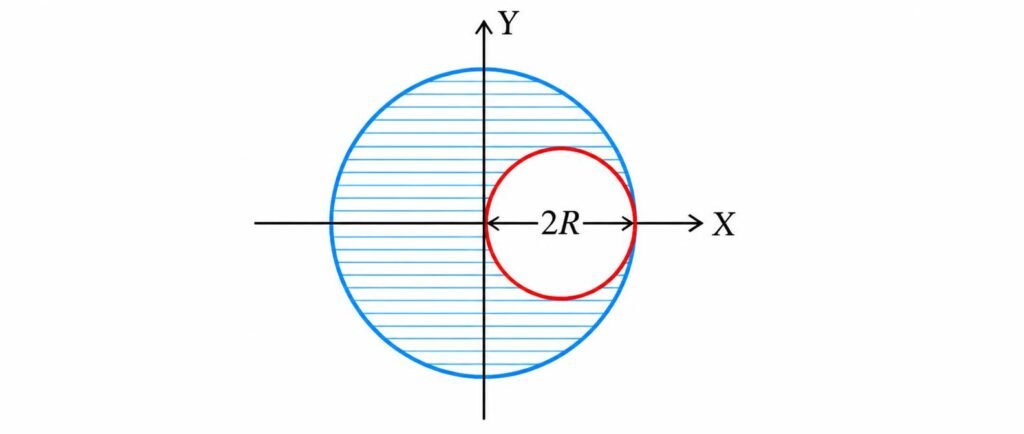
A sphere of radius $R$ is cut from a larger solid sphere of radius $2R$ as shown in the figure (cavity tangent to the outer sphere and passing through origin). The ratio of the moment of inertia of the smaller sphere to that of the rest part of the sphere about the Y-axis is:
A
$\frac{7}{8}$
B
$\frac{7}{40}$
C
$\frac{7}{57}$
D
$\frac{7}{64}$
Explanation
Using parallel axis theorem, $I_s = \frac{7}{5} m_s R^2$ and $I_L = \frac{64}{5} m_s R^2$. Remaining part has $I_r = \frac{57}{5} m_s R^2$. Ratio is $I_s / I_r = 7/57$.
Detailed Solution
Mass of smaller sphere is $m_s = \frac{4}{3}\pi R^3 \rho$. Large complete sphere has mass $M = \frac{4}{3}\pi (2R)^3 \rho = 8 m_s$. Moment of inertia of large sphere about Y-axis through its center: $I_L = \frac{2}{5} M (2R)^2 = \frac{2}{5}(8m_s)(4R^2) = \frac{64}{5} m_s R^2$. The center of the small sphere is shifted by distance $d = R$ from the Y-axis. By the parallel axis theorem: $I_s = I_{cm} + m_s d^2 = \frac{2}{5} m_s R^2 + m_s R^2 = \frac{7}{5} m_s R^2$. Moment of inertia of the remaining part about the Y-axis is $I_r = I_L - I_s = \frac{64}{5} m_s R^2 - \frac{7}{5} m_s R^2 = \frac{57}{5} m_s R^2$. The required ratio is $\frac{I_s}{I_r} = \frac{(7/5) m_s R^2}{(57/5) m_s R^2} = \frac{7}{57}$.