Looking for classes? Ksquare Career Institute, Bengaluru →

System of Particles and Rotational Motion
Moment of Inertia of Bodies with Cavities
1 question, with its answer.
-
A sphere of radius $R$ is cut from a larger solid sphere of radius $2R$ as shown in the figure (cavity tangent to the outer sphere and passing through origin). The ratio of the moment of inertia of the smaller sphere to that of the rest part of the sphere about the Y-axis is:
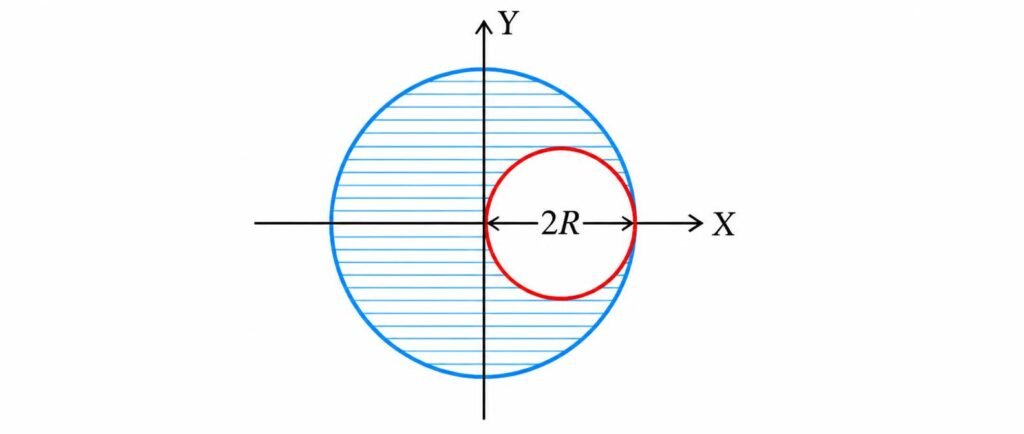
Using parallel axis theorem, $I_s = \frac{7}{5} m_s R^2$ and $I_L = \frac{64}{5} m_s R^2$. Remaining part has $I_r = \frac{57}{5} m_s R^2$. Ratio is $I_s / I_r = 7/57$.
Mass of smaller sphere is $m_s = \frac{4}{3}\pi R^3 \rho$. Large complete sphere has mass $M = \frac{4}{3}\pi (2R)^3 \rho = 8 m_s$. Moment of inertia of large sphere about Y-axis through its center: $I_L = \frac{2}{5} M (2R)^2 = \frac{2}{5}(8m_s)(4R^2) = \frac{64}{5} m_s R^2$. The center of the small sphere is shifted by distance $d = R$ from the Y-axis. By the parallel axis theorem: $I_s = I_{cm} + m_s d^2 = \frac{2}{5} m_s R^2 + m_s R^2 = \frac{7}{5} m_s R^2$. Moment of inertia of the remaining part about the Y-axis is $I_r = I_L - I_s = \frac{64}{5} m_s R^2 - \frac{7}{5} m_s R^2 = \frac{57}{5} m_s R^2$. The required ratio is $\frac{I_s}{I_r} = \frac{(7/5) m_s R^2}{(57/5) m_s R^2} = \frac{7}{57}$.
That is every question in Moment of Inertia of Bodies with Cavities.
Want a score?
Answers here are not saved. Practise as a test to be marked and see your progress.
Practise as a test