Looking for classes? Ksquare Career Institute, Bengaluru →

Linear momentum of a system of particles
-
A frictionless circular wire of unit radius is fixed on the horizontal plane. Two point particles of unit mass start moving simultaneously from point A ($\theta=\frac{\pi}{2}$) with identical uniform angular speeds in opposite directions, and meet again at point B ($\theta=-\frac{\pi}{2}$). During this time, which of the following figures schematically represent the magnitude of the total linear momentum P of the system, as a function of $\theta$?
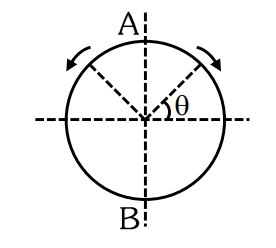 Taking $\theta$ as the angle of each particle from the horizontal: $\vec{P}_1+\vec{P}_2=(mv\sin\theta\hat{i}-mv\cos\theta\hat{j})+(-mv\sin\theta\hat{i}-mv\cos\theta\hat{j})$, so $P_{total}=|\vec{P}_1+\vec{P}_2|=2mv\cos\theta$. At $\theta=\pm\frac{\pi}{2}$, $P_{total}=0$; at $\theta=0$, $P_{total}=2mv$ (maximum). The graph is a single hump between $\frac{\pi}{2}$ and $-\frac{\pi}{2}$.