Looking for classes? Ksquare Career Institute, Bengaluru →

A gas is compressed isothermally to half its initial volume. The same gas is compressed separately through an adiabatic process until its volume is again reduced to half. Then
A
compressing the gas through adiabatic process will require more work to be done.
B
compressing the gas isothermally or adiabatically will require the same amount of work.
C
which of the case (whether compression through isothermal or through adiabatic process) requires more work will depend upon the atomicity of the gas.
D
compressing the gas isothermally will require more work to be done.
Explanation
The adiabatic curve is steeper, enclosing more area on compression.
Detailed Solution
Isothermal compression from V to $\frac{V}{2}$: $W = nRT\ln\left(\frac{V_f}{V_i}\right) = nRT\ln\left(\frac{1}{2}\right)$
Adiabatic compression: $W = \frac{k(V_f^{1-\gamma} - V_i^{1-\gamma})}{1 - \gamma}$, with $PV^\gamma$ = constant
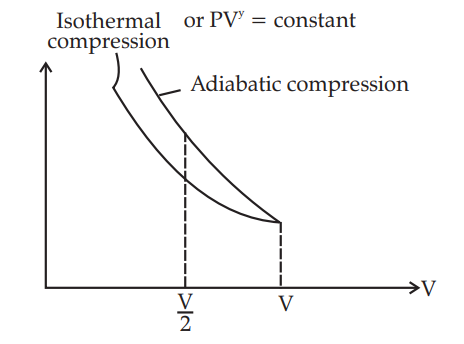
The area under the adiabatic compression curve is greater than that under the isothermal compression curve.
Hence compressing the gas through the adiabatic process requires more work.
Adiabatic compression: $W = \frac{k(V_f^{1-\gamma} - V_i^{1-\gamma})}{1 - \gamma}$, with $PV^\gamma$ = constant
The area under the adiabatic compression curve is greater than that under the isothermal compression curve.
Hence compressing the gas through the adiabatic process requires more work.