Looking for classes? Ksquare Career Institute, Bengaluru →

Physics
Wave Optics
40 questions from 24 papers, each with its answer.
- 40 questions
- 24 papers
- 2.27% of Physics
Polarisation - Malus' law
-
Two Polaroids $P_1$ and $P_2$ are placed with their axis perpendicular to each other. Unpolarised light $I_0$ is incident on $P_1$. A third polaroid $P_3$ is kept in between $P_1$ and $P_2$ such that its axis makes an angle $45^\circ$ with that of $P_1$. The intensity of transmitted light through $P_2$ is
Halve at the first polaroid, then apply $\cos^2 45^\circ$ twice.
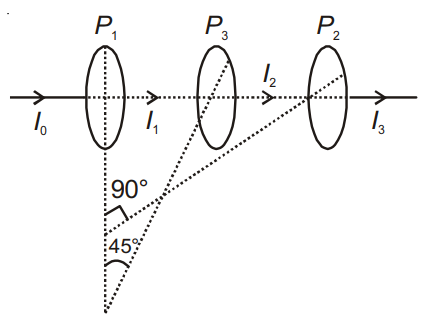
After $P_1$: $I_1 = \frac{I_0}{2}$
$I_2 = \frac{I_0}{2}\cos^2 45^\circ = \frac{I_0}{2}\times\frac{1}{2} = \frac{I_0}{4}$
$I_3 = \frac{I_0}{4}\cos^2 45^\circ = \frac{I_0}{8}$
Resolving power of optical instruments
-
The ratio of resolving powers of an optical microscope for two wavelengths $\lambda_1 = 4000$ Å and $\lambda_2 = 6000$ Å is
Resolving power is inversely proportional to wavelength.
Resolving power $\propto \frac{1}{\lambda}$ $\frac{R_1}{R_2} = \frac{\lambda_2}{\lambda_1} = \frac{6000\ Å}{4000\ Å} = \frac{3}{2}$
That is every question in Wave Optics for this filter.
Show all 40 questions Next: Dual Nature of Radiation and Matter
Want a score?
Answers here are not saved. Practise as a test to be marked and see your progress.
Practise as a test