Looking for classes? Ksquare Career Institute, Bengaluru →

Doppler effect
Appears in
Concepts tested here
- Component of source velocity
- Echo from a stationary reflector
- Observer approaching a receding source
All Questions
2015 AIPMT-II 1 question
-
A source of sound S emitting waves of frequency 100 Hz and an observer O are located at some distance from each other. The source is moving with a speed of 19.4 $ms^{-1}$ at an angle of $60^\circ$ with the source observer line as shown in the figure. The observer is at rest. The apparent frequency observed by the observer (velocity of sound in air 330 $ms^{-1}$) is:
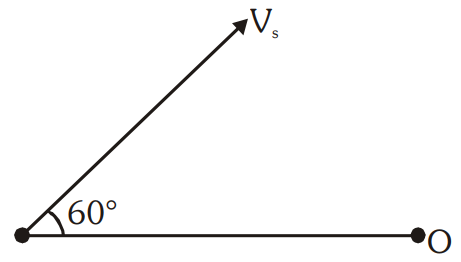 Component of source velocity towards the observer: $v_s\cos 60^\circ = \frac{19.4}{2} = 9.7$ m/s
$f_0 = f_s\left(\frac{v}{v - v_s\cos60^\circ}\right) = 100\left(\frac{330}{330 - 9.7}\right) \approx 103$ Hz
2014 AIPMT 1 question
-
A speeding motorcyclist sees traffic jam ahead of him. He slows down to 36 km/hour. He finds that traffic has eased and a car moving ahead of him at 18 km/hour is honking at a frequency of 1392 Hz. If the speed of sound is 343 m/s, the frequency of the honk as heard by him will be:$v_0 = 36$ km/h = 10 m/s (observer), $v_s = 18$ km/h = 5 m/s (source)
$n' = n\left[\frac{v + v_0}{v + v_s}\right] = 1392\left[\frac{343 + 10}{343 + 5}\right] = 1412$ Hz
2012 AIPMT-MAINS 1 question
-
A train moving at a speed of 220 $ms^{-1}$ towards a stationary object, emits a sound of frequency 1000 Hz. Some of the sound reaching the object gets reflected back to the train as echo. The frequency of the echo as detected by the driver of the train is: (speed of sound in air is 330 $ms^{-1}$)The train is both the moving source and, for the echo, the moving observer approaching the reflector.
$f' = f\left(\frac{v + v_o}{v - v_s}\right) = 1000\times\frac{330 + 220}{330 - 220}$
$= 1000\times\frac{550}{110} = 5000$ Hz