Looking for classes? Ksquare Career Institute, Bengaluru →

Physics
Work, Energy and Power
71 questions from 36 papers, each with its answer.
- 71 questions
- 36 papers
- 4.02% of Physics
Power
-
If $\vec{F} = (60\hat{i} + 15\hat{j} - 3\hat{k})$ N and $\vec{V} = (2\hat{i} - 4\hat{j} + 5\hat{k})$ m/s, then instantaneous power is :Instantaneous power: $P = \vec{F}\cdot\vec{v}$
$P = (60\hat{i} + 15\hat{j} - 3\hat{k})\cdot(2\hat{i} - 4\hat{j} + 5\hat{k})$
$= (60)(2) + (15)(-4) + (-3)(5) = 120 - 60 - 15$
$P = 45$ watt
Conservation of Mechanical Energy
-
A man is slipping on a frictionless inclined plane and a bag falls down from the same height. Then the speed of both is related as :On a frictionless incline only gravity does work (the normal force does no work).
By conservation of energy, for both the man and the bag: $mgh = \dfrac{1}{2}mv^2 \Rightarrow v = \sqrt{2gh}$
The speed depends only on the height fallen, not on the path or the mass. (The times taken are different.)
So $V_B = V_m$. -
The bob of simple pendulum having length l, is displaced from mean position to an angular position $\theta$ with respect to vertical. If it is released, then velocity of bob at lowest position :At angle $\theta$, the bob is at height $h = l - l\cos\theta = l(1 - \cos\theta)$ above the lowest point.
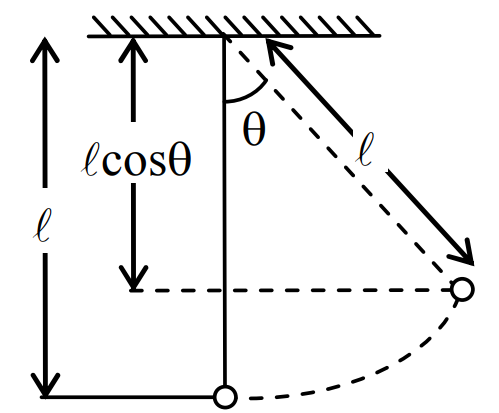
Potential energy at the extreme position = kinetic energy at the mean position:
$mgl(1 - \cos\theta) = \dfrac{1}{2}mv^2$
$v = \sqrt{2gl(1 - \cos\theta)}$
That is every question in Work, Energy and Power for this filter.
Show all 71 questions Next: System of Particles and Rotational Motion
Want a score?
Answers here are not saved. Practise as a test to be marked and see your progress.
Practise as a test