2018 Work, Energy and PowerMotion in a vertical circle – energy conservation Medium Question 23 of 71 in Work, Energy and Power

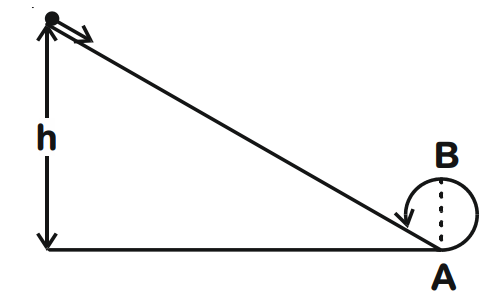
A body initially at rest and sliding along a frictionless track from a height h (as shown in the figure)…

A body initially at rest and sliding along a frictionless track from a height h (as shown in the figure) just completes a vertical circle of diameter AB = D. The height h is equal to
A $\frac{7}{5}D$
B D
C $\frac{3}{2}D$
D $\frac{5}{4}D$

The answer is D.
Solution

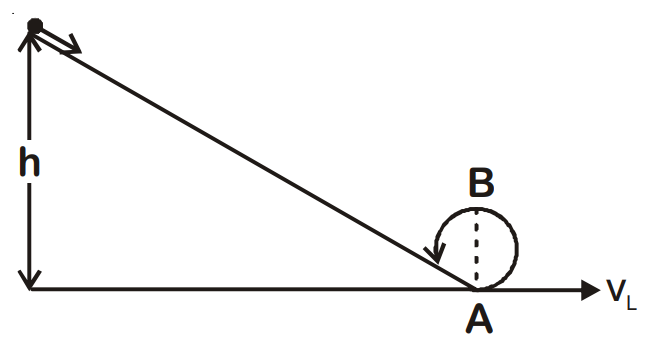
Minimum speed at the bottom is $\sqrt{5gR}$, so $h = 5R/2 = 5D/4$.


As the track is frictionless, total mechanical energy remains constant.
$T.M.E_I = T.M.E_F \Rightarrow 0 + mgh = \frac{1}{2}mv_L^2 + 0$
$h = \frac{v_L^2}{2g}$
For completing the vertical circle, $v_L = \sqrt{5gR}$
$h = \frac{5gR}{2g} = \frac{5}{2}R = \frac{5}{4}D$

Concept vertical-circle-minimum-height

Work, Energy and Power in past papers

71 questions from this chapter have appeared across 27 exam years.
