2004 AIPMT Work, Energy and PowerMotion in a vertical circle Medium Question 2 of 2 in Motion in a vertical circle

A stone is tied to a string of length '$l$' and is whirled in a vertical circle with the other end of the string as the centre. At a certain instant of time, the stone is at its lowest position and has a speed 'u'. The magnitude of the change in velocity as it reaches a position where the string is horizontal (g being acceleration due to gravity) is :-

A $\sqrt{u^2 - gl}$
B $u - \sqrt{u^2 - 2gl}$
C $\sqrt{2gl}$
D $\sqrt{2(u^2 - gl)}$

The answer is D.
Solution

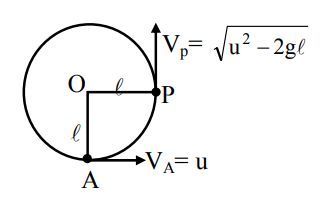
Let A be the lowest point (speed $V_A = u$, horizontal) and P the point where the string is horizontal (height $l$ above A).

By conservation of energy between A and P: $\dfrac{1}{2}mu^2 = \dfrac{1}{2}mV_P^2 + mgl$
$\Rightarrow V_P = \sqrt{u^2 - 2gl}$
At A the velocity is horizontal; at P (string horizontal) the velocity is vertical. So the angle between $\vec{V}_A$ and $\vec{V}_P$ is $90^\circ$.
Magnitude of change in velocity $= |\vec{V}_P - \vec{V}_A| = \sqrt{V_P^2 + V_A^2}$ (because the two vectors are perpendicular)
$= \sqrt{(u^2 - 2gl) + u^2} = \sqrt{2u^2 - 2gl}$
$= \sqrt{2(u^2 - gl)}$

Concept Vector change in velocity in vertical circular motion

Motion in a vertical circle in past papers

2 questions from this chapter have appeared across 2 exam years.
