Looking for classes? Ksquare Career Institute, Bengaluru →

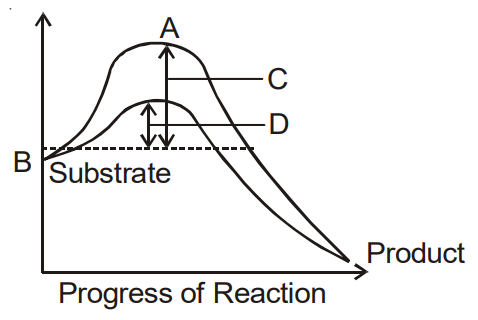
The figure given below shows the conversion of a substrate into product by an enzyme. In which one of the four options (1–4) the components of reaction labelled as A, B, C and D are identified correctly?
A
A – Potential energy, B – Transition state, C – Activation energy with enzyme, D – Activation energy without enzyme
B
A – Transition state, B – Potential energy, C – Activation energy without enzyme, D – Activation energy with enzyme
C
A – Potential energy, B – Transition state, C – Activation energy with enzyme, D – Activation energy without enzyme
D
A – Activation energy with enzyme, B – Transition state, C – Activation energy without enzyme, D – Potential energy
Detailed Solution
The graph plots potential energy (y-axis) against the progress of the reaction (x-axis), so the label B on the y-axis is the potential energy.
The substrate must pass through a high-energy, unstable intermediate structure before forming the product; the peak of the curve, labelled A, is this transition state.
The difference in energy between the substrate and the transition state is the activation energy.
The taller curve is for the reaction without the enzyme, so the larger energy gap, C, is the activation energy without enzyme.
The enzyme lowers the energy barrier; the smaller gap under the lower curve, D, is the activation energy with enzyme.
Hence A – transition state, B – potential energy, C – activation energy without enzyme, D – activation energy with enzyme.
The substrate must pass through a high-energy, unstable intermediate structure before forming the product; the peak of the curve, labelled A, is this transition state.
The difference in energy between the substrate and the transition state is the activation energy.
The taller curve is for the reaction without the enzyme, so the larger energy gap, C, is the activation energy without enzyme.
The enzyme lowers the energy barrier; the smaller gap under the lower curve, D, is the activation energy with enzyme.
Hence A – transition state, B – potential energy, C – activation energy without enzyme, D – activation energy with enzyme.