Looking for classes? Ksquare Career Institute, Bengaluru →

Enzymes
Appears in
Concepts tested here
- Activation energy
- Nature of enzymes
- Transition state
All Questions
2013 NEET 1 question
-
Transition state structure of the substrate formed during an enzymatic reaction is:When the substrate binds to the enzyme a new, high-energy transition state structure is formed. It is transient and unstable.
2010 AIPMT-MAINS 2 questions
-
The figure given below shows the conversion of a substrate into product by an enzyme. In which one of the four options (1–4) the components of reaction labelled as A, B, C and D are identified correctly?
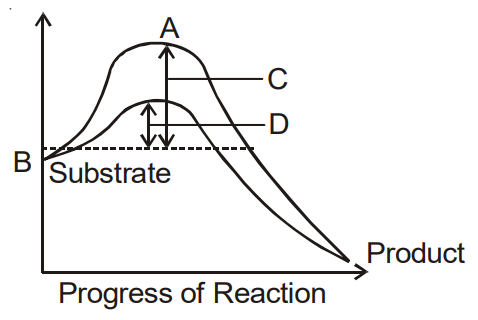 The graph plots potential energy (y-axis) against the progress of the reaction (x-axis), so the label B on the y-axis is the potential energy.
The substrate must pass through a high-energy, unstable intermediate structure before forming the product; the peak of the curve, labelled A, is this transition state.
The difference in energy between the substrate and the transition state is the activation energy.
The taller curve is for the reaction without the enzyme, so the larger energy gap, C, is the activation energy without enzyme.
The enzyme lowers the energy barrier; the smaller gap under the lower curve, D, is the activation energy with enzyme.
Hence A – transition state, B – potential energy, C – activation energy without enzyme, D – activation energy with enzyme. -
Three of the following statements about enzymes are correct and one is wrong. Which one is wrong?Almost all enzymes are proteins. The exceptions are some nucleic acids that behave like enzymes, called ribozymes (RNA enzymes). No enzyme is a lipid.
So the statement 'most enzymes are proteins but some are lipids' is wrong.
Each enzyme shows its highest activity at a particular optimum pH (true).
Enzymes are generally denatured at high temperatures, but enzymes isolated from thermophilic organisms living in hot vents and sulphur springs are stable and retain their catalytic power even at 80–90 °C (true).
Enzymes are highly specific for their substrates (true).
Hence the wrong statement is that some enzymes are lipids.