Looking for classes? Ksquare Career Institute, Bengaluru →

Electrocardiograph
Appears in
Concepts tested here
- ECG waves
- P-wave
All Questions
2013 NEET 1 question
-
The diagram given here is the standard ECG of a normal person. The P-wave represents the:
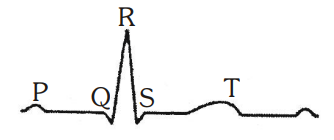 The P-wave represents the electrical excitation (depolarisation) of the atria, which leads to the contraction of both atria.
2011 AIPMT-MAINS 1 question
-
Given below is the ECG of a normal human. Which one of its components is correctly interpreted below?
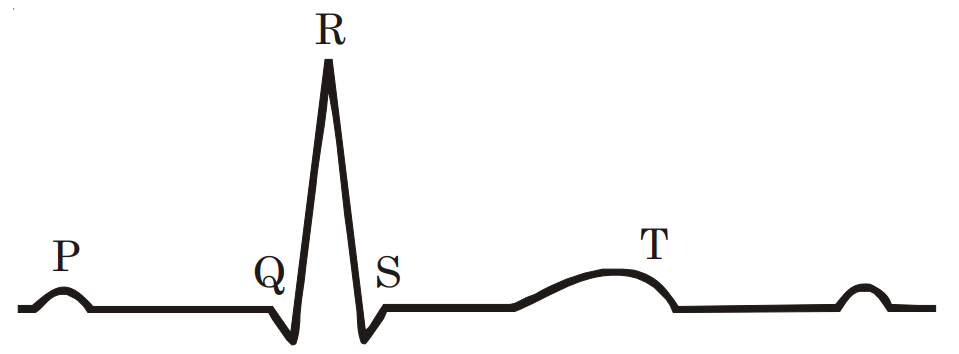 The P-wave represents the electrical excitation (depolarisation) of the atria, which leads to the contraction of both atria, not of the left atrium only.
The QRS complex represents the depolarisation of the ventricles, which initiates ventricular contraction (systole).
Each ventricular contraction pushes blood into the arteries and produces one pulse; so by counting the QRS complexes in a given time one can find the heart beat (pulse) rate. Thus one QRS complex corresponds to one complete pulse.
The T-wave represents the return of the ventricles from the excited to the normal state (repolarisation); its end marks the end of systole, not the start of contraction.
The ECG records electrical activity; its peaks do not measure systolic and diastolic blood pressures.
Hence the correct interpretation is complex QRS – one complete pulse.