Looking for classes? Ksquare Career Institute, Bengaluru →

Biology
Organisms and Populations
90 questions from 35 papers, each with its answer.
- 90 questions
- 35 papers
- 2.55% of Biology
Population Interactions – Competition
-
Two different species can not live for long duration in the same niche or habitat. This law is : -G. F. Gause, working with two species of Paramecium, showed that two closely related species competing for the same resources cannot coexist indefinitely; the inferior competitor is eliminated.
This is called the competitive exclusion principle (it is also known as Gause's principle).
Allen's rule relates to shorter extremities in mammals of colder climates; Weismann's theory concerns the continuity of germplasm.
So, as per the answer key, this law is the competitive exclusion principle.
Exponential Growth
-
The semilog of per minute growing bacteria is plotted against time. What will be the shape of graph : -In the growth phase, the rate of increase of bacteria is proportional to their number: $\dfrac{dN}{dt} = \mu N$
Integrating: $N = N_0e^{\mu t}$
Taking logarithms: $\log N = \log N_0 + \mu t$ (in natural log form)
This has the form $y = mx + c$ with $y = \log N$, $m = \mu$ (positive) and $x = t$.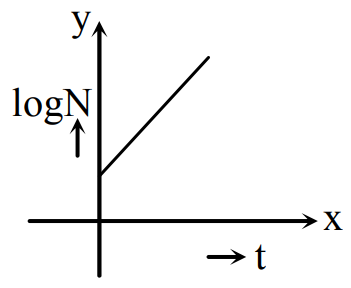
So a semilog plot (log of number against time) of growing bacteria is an ascending straight line.
That is every question in Organisms and Populations for this filter.
Want a score?
Answers here are not saved. Practise as a test to be marked and see your progress.
Practise as a test