Looking for classes? Ksquare Career Institute, Bengaluru →

Photosynthesis in Higher Plants
C4 Pathway
11 questions from 9 papers, each with its answer.
- questions
- 11
- papers
- 9
- years asked, 2017–2026
- 3 of 10
- of Photosynthesis in Higher Plants
- 12.09%
Appears in
Concepts tested
- Hatch and Slack pathway 3
- Kranz anatomy 2
- C4 pathway
- CO2 concentrating mechanism
- Energy cost of the C4 pathway
- first stable product in C4 plants
- PEP as CO2 acceptor in C4 plants
- Photorespiration in C3 and C4 plants
All Questions
2022 1 question
-
Given below are two statements: Statement I: The primary $CO_2$ acceptor in $C_4$ plants is phosphoenolpyruvate and is found in the mesophyll cells. Statement II: Mesophyll cells of $C_4$ plants lack RuBisCO enzyme In the light of the above statements, choose the correct answer from the options given below.
2021 1 question
-
The first stable product of $CO_2$ fixation in sorghum is:
2019 Odisha 1 question
-
In Hatch and Slack pathway, the primary $CO_2$ acceptor is
2012 AIPMT-PRE 1 question
-
A process that makes important difference between C3 and C4 plants isIn $C_3$ plants RuBisCO also binds $O_2$, so photorespiration occurs and some fixed carbon is lost.
$C_4$ plants concentrate $CO_2$ at the site of RuBisCO in the bundle sheath cells, so photorespiration does not occur.
This lack of photorespiration is the important difference; it gives $C_4$ plants higher productivity.
2011 AIPMT-MAINS 1 question
-
In Kranz anatomy, the bundle sheath cells haveKranz anatomy is the special leaf anatomy of $C_4$ plants, in which large bundle sheath cells are arranged like a wreath around the vascular bundles.
The bundle sheath cells may form several layers; they are characterised by a large number of chloroplasts, thick walls impervious to gaseous exchange and no intercellular spaces.
The thick, gas-tight walls keep the $CO_2$ released from the $C_4$ acid concentrated around RuBisCO, which prevents photorespiration.
Thin walls with intercellular spaces are features of the mesophyll cells.
Hence the bundle sheath cells have thick walls, no intercellular spaces and a large number of chloroplasts.
2010 AIPMT-MAINS 2 questions
-
Kranz anatomy is one of the characteristics of the leaves ofKranz anatomy is the special leaf anatomy of $C_4$ plants: the vascular bundles are surrounded by a wreath of large bundle sheath cells that have many chloroplasts, thick walls and no intercellular spaces.
$C_4$ plants are mostly tropical grasses such as sugarcane, maize and sorghum.
Potato, wheat and mustard are $C_3$ plants and do not have Kranz anatomy.
Hence Kranz anatomy is a characteristic of the leaves of sugarcane. -
Study the pathway given below:
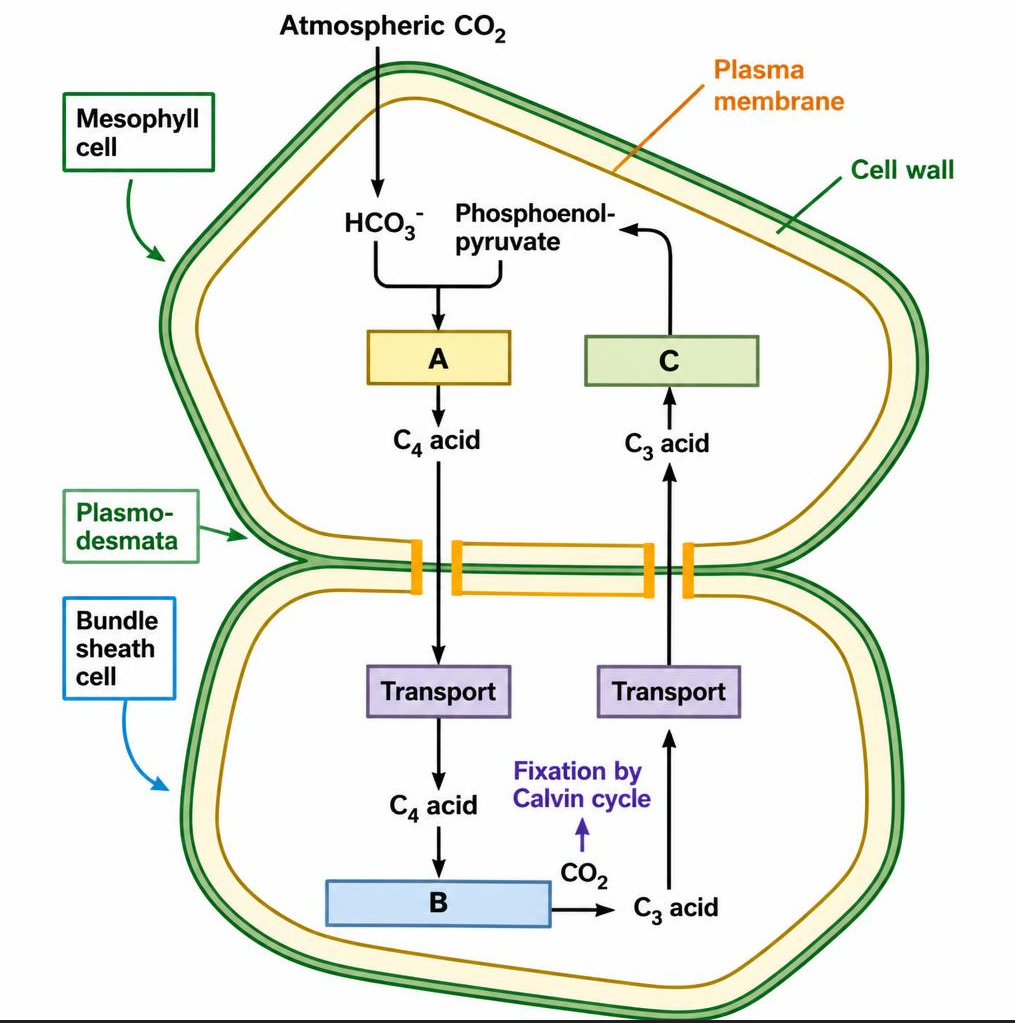
In which of the following options are correct words for all the three blanks A, B and C indicated?The figure is the Hatch and Slack ($C_4$) pathway, showing a mesophyll cell and a bundle sheath cell.
A (in the mesophyll cell): atmospheric $CO_2$, as $HCO_3^-$, combines with the 3-carbon acceptor phosphoenol pyruvate (PEP) in the presence of PEP carboxylase to form the $C_4$ acid oxaloacetic acid. This is fixation.
The $C_4$ acid (malic or aspartic acid) is transported to the bundle sheath cell.
B (in the bundle sheath cell): the $C_4$ acid is broken down to release $CO_2$ and a 3-carbon acid. This is decarboxylation; the $CO_2$ released enters the Calvin cycle.
C (back in the mesophyll cell): the $C_3$ acid is transported back and converted into PEP again. This is regeneration of the primary acceptor.
Hence A – fixation, B – decarboxylation, C – regeneration.
2008 AIPMT 1 question
-
In leaves of $C_4$ plants malic acid synthesis during $CO_2$ fixation occurs in:$C_4$ plants show Kranz anatomy, with two types of photosynthetic cells: mesophyll cells and bundle sheath cells.
The primary $CO_2$ acceptor is the 3-carbon compound phosphoenol pyruvate (PEP), present in the mesophyll cells.
The enzyme PEP carboxylase (PEPcase) of the mesophyll cells fixes $CO_2$ to form the 4-carbon oxaloacetic acid (OAA).
OAA is then converted into other 4-carbon acids, malic acid or aspartic acid, in the mesophyll cells themselves.
Malic acid is then transported to the bundle sheath cells, where it is decarboxylated to release $CO_2$ for the Calvin cycle.
So malic acid synthesis occurs in the mesophyll cells; the bundle sheath is the site of its breakdown, not its synthesis.
2007 AIPMT-PRE 1 question
-
In the leaves of $C_4$ plants, malic acid formation during $CO_2$ fixation occurs in the cells ofThe leaves of $C_4$ plants show Kranz anatomy, with mesophyll cells and large bundle sheath cells around the vascular bundles.
In $C_4$ plants the $C_4$ cycle occurs in the mesophyll cells and the $C_3$ (Calvin) cycle occurs in the bundle sheath cells.
The primary $CO_2$ acceptor, phosphoenol pyruvate (PEP), is present in the mesophyll cells, where the enzyme PEP carboxylase fixes $CO_2$ to form oxaloacetic acid (OAA).
OAA is then reduced to malic acid (or converted to aspartic acid) in the mesophyll cells themselves.
The malic acid is transported to the bundle sheath cells, where it is broken down to release $CO_2$ for the Calvin cycle.
So malic acid formation occurs in the mesophyll cells.
2005 AIPMT 2 questions
-
As compared to a $C_3$-plant, how many additional molecules of ATP are needed for net production of one molecule of hexose sugar by $C_4$-plants -In $C_3$ plants the Calvin cycle needs 3 ATP and 2 NADPH for the fixation of one $CO_2$, so for one hexose (6 $CO_2$) it needs 18 ATP and 12 NADPH.
$C_4$ plants first fix $CO_2$ in the mesophyll cells and then release it in the bundle sheath cells for the Calvin cycle.
To regenerate phosphoenol pyruvate (PEP) from pyruvate in the mesophyll cells, the enzyme pyruvate phosphate dikinase uses 2 high energy bonds of ATP (ATP is converted to AMP) for every $CO_2$ fixed.
So 2 extra ATP are needed for each $CO_2$, i.e. $2 \times 6 = 12$ extra ATP for one hexose.
Total requirement in $C_4$ plants $= 18 + 12 = 30$ ATP per hexose.
So $C_4$ plants need twelve additional ATP molecules compared with $C_3$ plants. -
Photosynthesis in $C_4$ plants is relatively less limited by atmospheric $CO_2$ levels becauseIn $C_4$ plants, $CO_2$ is first fixed in the mesophyll cells by PEP carboxylase into a 4-carbon acid.
This acid moves into the bundle sheath cells and is decarboxylated, releasing $CO_2$ there.
This works as a $CO_2$ pump: it raises the concentration of $CO_2$ in the bundle sheath cells, where RuBisCO and the Calvin cycle are located, to a level much higher than in the atmosphere.
Because of this effective pumping, RuBisCO works at near-saturating $CO_2$ even when the atmospheric $CO_2$ is low, and photorespiration is almost eliminated.
So photosynthesis is less limited by atmospheric $CO_2$ levels; the $CO_2$ compensation point of $C_4$ plants is very low.
RuBisCO itself is the same enzyme as in $C_3$ plants, and the fixation by PEP carboxylase or the formation of 4-carbon acids is only a part of this mechanism.
So the reason is the effective pumping of $CO_2$ into the bundle sheath cells.