Looking for classes? Ksquare Career Institute, Bengaluru →

Bryophytes
Appears in
Concepts tested here
- Dominant gametophyte
- Liverworts
- Marchantia thallus
- Peat moss
All Questions
2014 AIPMT 1 question
-
Which of the following is responsible for peat formation?Sphagnum (peat moss) accumulates in bogs and forms peat, which is used as fuel and as packing material.
2011 AIPMT-MAINS 1 question
-
Examine the figure given below and select the right option giving all the four parts (A, B, C, D) correctly identified.
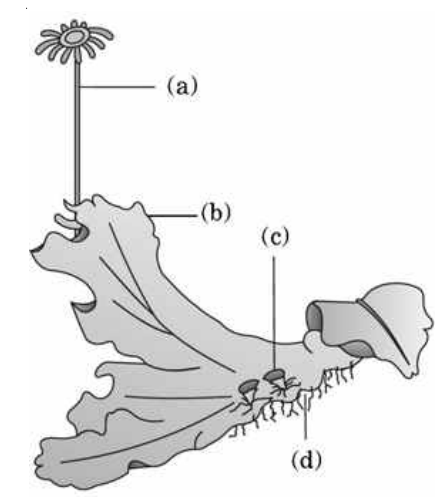 The figure shows the female plant of the liverwort $Marchantia$.
A is the stalked, umbrella-like structure with rays that bears the archegonia: the archegoniophore.
B is the flat, dorsiventral, dichotomously branched plant body bearing it: the female thallus.
C is the small cup-shaped structure on the upper surface of the thallus containing gemmae (green, multicellular asexual buds): the gemma cup.
D is the unicellular hair-like structures on the lower surface that fix the thallus to the substratum: the rhizoids. Bryophytes have no true roots.
Hence A is archegoniophore, B is female thallus, C is gemma cup and D is rhizoids.
2011 AIPMT-PRE 1 question
-
Archegoniophore is present in$Marchantia$ is a dioecious liverwort; its sex organs are borne on special upright stalked branches of the thallus.
The stalk bearing the archegonia (female sex organs) at its tip is called the archegoniophore, and the stalk bearing antheridia is called the antheridiophore.
In $Funaria$ (a moss) the archegonia are borne at the tip of the leafy shoot, not on an archegoniophore.
$Chara$ is an alga with oogonia (no archegonia), and in $Adiantum$ (a fern) the archegonia are borne on the prothallus.
Hence the archegoniophore is present in $Marchantia$.
2010 AIPMT-PRE 1 question
-
Male and female gametophytes are independent and free-living in$Sphagnum$ is a moss (bryophyte). In bryophytes the main plant body is the haploid gametophyte, which is green, photosynthetic, independent and free-living.
The male and female sex organs (antheridia and archegonia) are borne on these free-living gametophytes; the sporophyte is dependent on the gametophyte.
Mustard and castor are angiosperms and $Pinus$ is a gymnosperm; in seed plants the male gametophyte (pollen grain) and female gametophyte (embryo sac / endosperm) are highly reduced and remain dependent on the sporophyte.
Hence independent, free-living male and female gametophytes occur in $Sphagnum$.