Looking for classes? Ksquare Career Institute, Bengaluru →

Plant Kingdom
Start Practice Clear paper filter
-
Examine the figures A, B, C and D. In which one of the four options are all the items A, B, C and D correct?
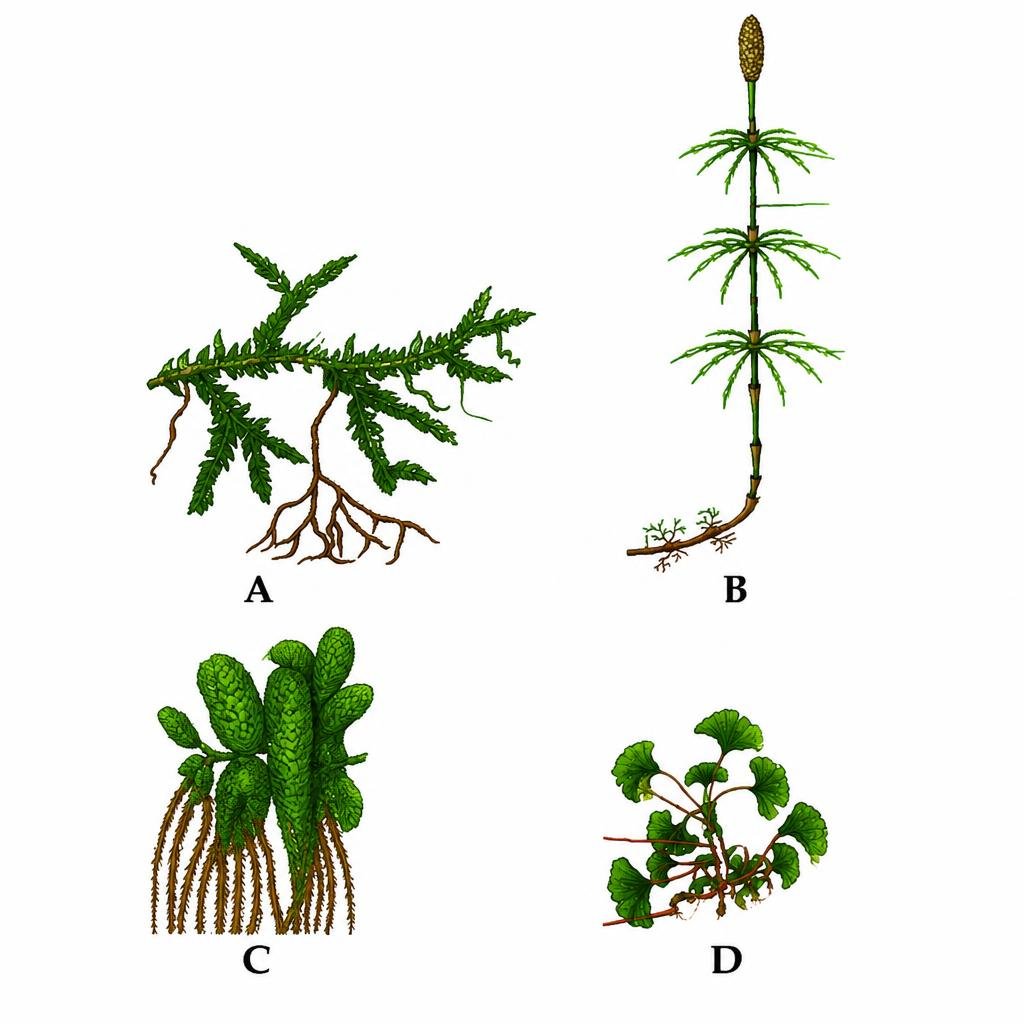 Figure A shows a creeping, branched plant with small scale-like leaves and roots arising from the stem: $Selaginella$ (a pteridophyte, the 'spike moss').
Figure B shows an erect, jointed stem with whorls of slender branches at the nodes and a terminal cone (strobilus): $Equisetum$ (horsetail).
Figure C shows a floating aquatic fern with rounded leaves above and root-like submerged leaves below: $Salvinia$.
Figure D shows a shoot with fan-shaped leaves: $Ginkgo$, a gymnosperm.
Hence A – $Selaginella$, B – $Equisetum$, C – $Salvinia$, D – $Ginkgo$. -
Which one of the following is monoecious?A monoecious plant bears both male and female reproductive structures on the same individual; in a dioecious plant they are on different individuals.
In $Pinus$ the male cones (microsporangiate strobili) and female cones (macrosporangiate strobili) are borne on the same tree, so it is monoecious.
In $Cycas$ the male cones and megasporophylls are borne on different trees (dioecious).
$Marchantia$ has separate male and female thalli (dioecious), and the date palm has separate male and female trees (dioecious).
Hence $Pinus$ is monoecious.