Looking for classes? Ksquare Career Institute, Bengaluru →

Sexual Reproduction in Flowering Plants
Showing 1–25 of 34 questions
-
Arrange the following in the correct developmental sequence related to microsporogenesis: I. Microspore tetrads II. Sporogenous tissue III. Pollen grains IV. Pollen mother cells Choose the CORRECT answer from the options given below:A IV, I, III, IIB II, IV, III, IC II, IV, I, IIID I, IV, III, II
-
Which one of the following is a triploid cell?A Central cellB Primary endosperm cellC ZygoteD Synergid
-
Which one of the following types of pollination brings genetically different types of pollen grains to the stigma?A GeitonogamyB AutogamyC XenogamyD Cleistogamy
-
Which one of the following is an appropriate example of 'sexual deceit'?A Female wasp and figB Cuckoo and crowC $Ophrys$ and bumblebeeD Sea anemone and clown fish
-
Assertion (A): Both wind and water pollinated flowers are not very colourful and do not produce nectar.Reason (R): The flowers produce enormous amount of pollen grains in wind and water pollinated flowers.A Both A and R are true and R is the correct explanation of A.B Both A and R are true but R is NOT the correct explanation of A.C A is true but R is false.D A is false but R is true.
Both statements are true facts of abiotic pollination, but Reason does not explain why they lack colour/nectar (lack of biotic pollinators is the cause).
Wind and water pollinated flowers do not need visual cues or rewards like nectar because their vectors are abiotic, making Assertion true. They produce copious pollen to compensate for random passive dispersal loss, making Reason true. However, R is not the explanation for A. -
Assertion (A): A typical unfertilized, angiosperm embryo sac at maturity is 8 nucleate and 7-celled.Reason (R): The egg apparatus has 2 polar nuclei.A Both A and R are true and R is the correct explanation of A.B Both A and R are true but R is NOT the correct explanation of A.C A is true but R is false.D A is false but R is true.
Assertion is true; Reason is false because polar nuclei reside in the large central cell, not in the egg apparatus.
A mature angiosperm female gametophyte has 7 cells and 8 nuclei (3 antipodals, 1 central cell with 2 polar nuclei, and a 3-celled egg apparatus comprising 1 egg cell and 2 synergids). The polar nuclei are in the central cell, not the egg apparatus, so Reason is false. -
Match List-I with List-II.
Column I
- A. Scutellum
- B. Non-albuminous seed
- C. Epiblast
- D. Perisperm
Column II
- I. Persistent nucellus
- II. Cotyledon of Monocot seed
- III. Groundnut
- IV. Rudimentary cotyledon
Correct answer: A → II, B → III, C → IV, D → I
A-II, B-III, C-IV, D-I.
Scutellum is the shield-shaped cotyledon of monocots (II). Groundnut is a non-endospermic/non-albuminous seed (III). Epiblast represents the remains of the second cotyledon in grass embryos (IV). Perisperm is the persistent remnants of nucellar tissue (e.g., black pepper) (I). -
Assertion (A): Cells of the tapetum possess dense cytoplasm and generally have more than one nucleus.Reason (R): Presence of more than one nucleus in the tapetum increases the efficiency of nourishing the developing microspore mother cells.A Both A and R are true and R is the correct explanation of AB Both A and R are true but R is not the correct explanation of AC A is true but R is falseD A is false but R is true
Assertion is true; Reason is false (tapetum nourishes developing microspores / pollen grains, and polyploidy arises due to endomitosis without cytokinesis, not MMC nourishment efficiency).
Tapetal cells feature dense cytoplasm and multinucleate or polyploid state due to endomitosis. Tapetum primarily functions to nourish developing microspores/pollen grains. Stating that multinucleation specifically evolved to nourish microspore mother cells is incorrect. -
How many meiotic and mitotic divisions need to occur for the development of a mature female gametophyte from the megaspore mother cell in an angiosperm plant?A 2 Meiosis and 3 MitosisB 1 Meiosis and 2 MitosisC 1 Meiosis and 3 MitosisD No Meiosis and 2 Mitosis
1 meiosis forms 4 megaspores (1 functional survives); 3 sequential free-nuclear mitotic divisions form the 8-nucleate embryo sac.
From 1 diploid Megaspore Mother Cell (MMC): 1 meiotic division produces a linear tetrad of 4 haploid megaspores. Three degenerate, leaving 1 functional megaspore. This functional megaspore undergoes 3 consecutive mitotic nuclear divisions to form an 8-nucleate, 7-celled mature female gametophyte (monosporic development). -
Identify the set of correct statements: A. The flowers of $Vallisneria$ are colourful and produce nectar B. The flowers of waterlily are not pollinated by water. C. In most of water-pollinated species, the pollen grains are protected from wetting. D. Pollen grains of some hydrophytes are long and ribbon like. E. In some hydrophytes, the pollen grains are carried passively inside water. Choose the correct answer from the options given below:A A, C, D and E onlyB B, C, D and E onlyC C, D and E onlyD A B, C and D only
-
Identify the correct description about the given figure:
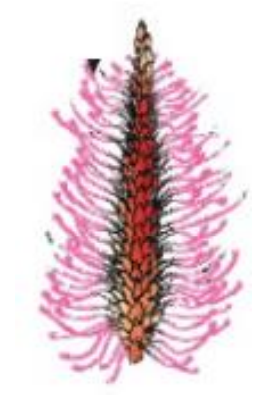 A Cleistogamous flowers showing autogamy.B Compact inflorescence showing complete autogamy.C Wind pollinated plant inflorescence showing flowers with well exposed stamens.D Water pollinated flowers showing stamens with mucilaginous covering.
 -
Which part of the ovule stores reserve food materials?A NucellusB IntegumentC PlacentaD FunicleThe nucellus is a mass of cells within the ovule, enclosed by the integument(s), and it has abundant reserve food materials.
-
Pollen grains remain preserved as fossils due to the presence of:A Epidermal layerB TapetumC Exine layerD Intine layerThe exine layer of the pollen wall is made of sporopollenin, one of the most resistant organic materials known, which allows pollen grains to be preserved as fossils.
-
Large, colourful, fragrant flowers with nectar are seen in:A wind pollinated plantsB insect pollinated plantsC bird pollinated plantsD bat pollinated plants
Insect-pollinated flowers are large, colourful, fragrant and rich in nectar.
Majority of insect-pollinated flowers are large, colourful, fragrant flowers and rich in nectar. These characteristics attract insects and thus help in pollination. -
In angiosperm, the haploid, diploid and triploid structures of a fertilized embryo sac sequentially are:A Synergids, antipodals and Polar nucleiB Synergids, Primary endosperm nucleus and zygoteC Antipodals, synergids, and primary endosperm nucleusD Synergids, Zygote and Primary endosperm nucleus
Synergids are haploid, the zygote is diploid, and the primary endosperm nucleus is triploid.
In angiosperms, the haploid, diploid and triploid structures of a fertilised embryo sac sequentially are: Synergids, Zygote and Primary endosperm nucleus. -
What is the function of tassels in the corn cob?A To protect seedsB To attract insectsC To trap pollen grainsD To disperse pollen grains
The tassels represent the stigma and style and trap wind-borne pollen.
Wind pollinated flower e.g. Zea mays (maize) have non-essential whorls such as calyx, corolla, bracts and bracteoles that are not showy. Flowers are devoid of scent and nectar. The tassels represent the stigma and style. Pollen grains are dry, very small sized, non-sticky and unwettable, so that they can be carried by wind to long distances. Stigma is hairy, feathery that catches the wind borne pollens. -
In which of the following sets of families, the pollen grains are viable for months?A Solanaceae, Poaceae and LiliaceaeB Brassicaceae, Liliaceae and PoaceaeC Rosaceae, Liliaceae and PoaceaeD Leguminosae, Solanaceae and RosaceaeIn some species belonging to families like Leguminosae, Solanaceae, and Rosaceae, pollen grains maintain their viability for several months.
-
Transfer of pollen grains from anther to stigma of another flower of same plant is known as:A GeitonogamyB XenogamyC AutogamyD CleistogamyGeitonogamy is the transfer of pollen grains from the anther of one flower to the stigma of another flower on the same plant. (Xenogamy is transfer between flowers on different plants; autogamy is self-pollination within the same flower.)
-
In angiosperms the correct sequence of events in formation of female gametophyte in the ovule is: (A) 3 successive free nuclear divisions functional megaspore. (B) Degeneration of 3 megaspores. (C) Meiotic division in megaspore mother cell. (D) Migration of 3 nuclei towards each pole. (E) Formation of wall resulting in seven celled embryosac. Choose the correct answer from the options given below:A (A), (B), (C), (D), (E)B (C), (E), (A), (D), (B)C (B), (C), (A), (D), (E)D (C), (B), (A), (D), (E)The correct sequence is: Meiotic division in the megaspore mother cell producing four megaspores (C) → Degeneration of 3 of the 4 megaspores, leaving one functional megaspore (B) → 3 successive free nuclear divisions of the functional megaspore (A) → Migration of nuclei (3 towards each pole) (D) → Formation of cell walls resulting in the seven-celled, eight-nucleate embryo sac (E). Order: C, B, A, D, E.
-
Given below are two statements: Statement I: Cleistogamous flowers are invariably autogamous Statement II: Cleistogamy is disadvantageous as there is no chance for cross pollination In the light of the above statements, choose the correct answer from the options given below.A Statement I is incorrect but Statement II is correctB Both Statement I and Statement II are correctC Both Statement I and Statement II are incorrectD Statement I is correct but Statement II is incorrect
-
Identify the incorrect statement related to Pollination:A Moths and butterflies are the most dominant pollinating agents among insectsB Pollination by water is quite rare in flowering plantsC Pollination by wind is more common amongst abiotic pollinationD Flowers produce foul odours to attract flies and beetles to get pollinated
-
Which part of the fruit, labelled in the given figure makes it a false fruit?
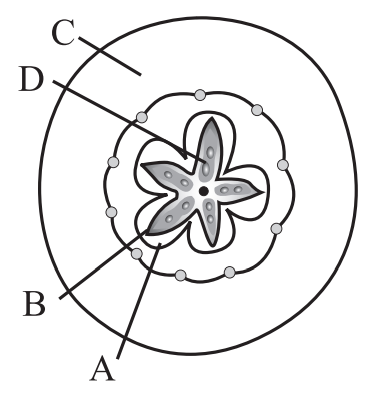 A D → SeedB A → MesocarpC B → EndocarpD C → Thalamus
 -
A typical angiosperm embryo sac at maturity is:A 7- nucleate and 8-celledB 7- nucleate and 7-celledC 8- nucleate and 8- celledD 8-nucleate and 7- celled
-
The term used for transfer of pollen grains from anthers of one plant to stigma of different plant which, during pollination, brings genetically different types of pollen grains to stigma, is:A GeitonogamyB ChasmogamyC CleistogamyD Xenogamy
-
In some members of which of the following pairs of families, pollen grains retain their viability for months after release?A Poaceae ; LeguminosaeB Poaceae ; SolanaceaeC Rosaceae ; LeguminosaeD Poaceae ; Rosaceae