Looking for classes? Ksquare Career Institute, Bengaluru →

Chemistry
Alcohols, Phenols and Ethers
65 questions from 33 papers, each with its answer.
- 65 questions
- 33 papers
- 3.69% of Chemistry
Williamson ether synthesis
-
The compound A on treatment with Na gives B, and with $PCl_5$ gives C. B and C react together to give diethyl ether. A, B and C are in the order
Sodium ethoxide + ethyl chloride gives diethyl ether by $S_N2$.
$C_2H_5OH\ (A) \xrightarrow{Na} C_2H_5O^-Na^+\ (B)$
$C_2H_5OH\ (A) \xrightarrow{PCl_5} C_2H_5Cl\ (C)$
$C_2H_5O^-Na^+\ (B) + C_2H_5Cl\ (C) \xrightarrow{S_N2} C_2H_5OC_2H_5$
So A, B and C are $C_2H_5OH$, $C_2H_5ONa$ and $C_2H_5Cl$.
Reimer–Tiemann reaction
-
In the reaction:
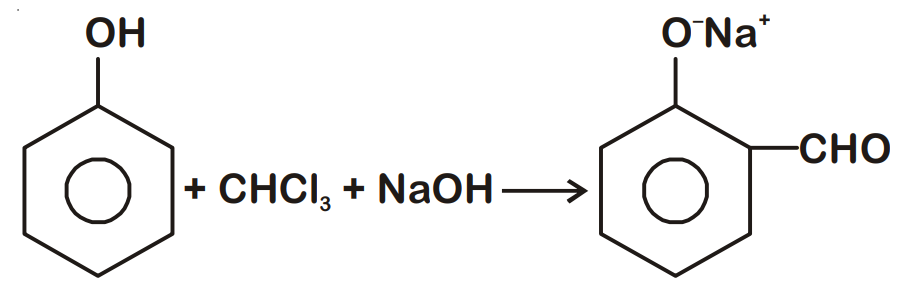
The electrophile involved isDichlorocarbene, from $\alpha$-elimination of chloroform, is the electrophile.
It is the Reimer–Tiemann reaction. The electrophile formed is $:CCl_2$ (dichlorocarbene) according to the following reactions: $CHCl_3 + OH^- \rightleftharpoons \overset{\ominus}{C}Cl_3 + H_2O$ $\overset{\ominus}{C}Cl_3 \rightarrow :CCl_2 + Cl^-$ (electrophile)
That is every question in Alcohols, Phenols and Ethers for this filter.
Show all 65 questions Next: Aldehydes, Ketones and Carboxylic Acids
Want a score?
Answers here are not saved. Practise as a test to be marked and see your progress.
Practise as a test