Looking for classes? Ksquare Career Institute, Bengaluru →

Chemistry
Aldehydes, Ketones and Carboxylic Acids
91 questions from 38 papers, each with its answer.
- 91 questions
- 38 papers
- 5.17% of Chemistry
Rosenmund reduction
-
The following conversion is known as:
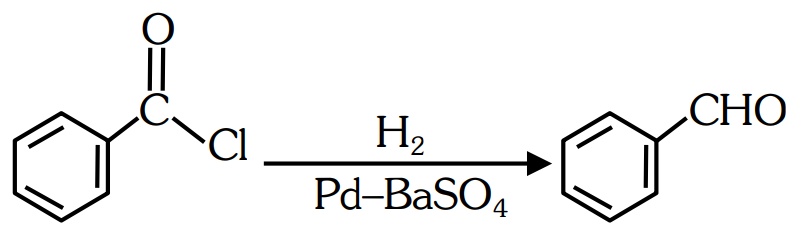 Selective reduction of an acid chloride to an aldehyde using $H_2$ over a Pd-$BaSO_4$ (poisoned palladium) catalyst is known as the Rosenmund reaction.
Aldol condensation of acetone
-
Consider the given reaction: $CH_3COCH_3\xrightarrow{dil\ Ba(OH)_2} "X"$. The functional groups present in compound "X" are:"Acetone undergoes a base-catalysed aldol reaction (with dilute $Ba(OH)_2$) to give diacetone alcohol: $CH_3-CO-CH_3\xrightarrow{Ba(OH)_2}CH_3-C(OH)(CH_3)-CH_2-CO-CH_3$. The functional groups present in this aldol product are alcohol and ketone.
Nitrile hydrolysis followed by Hell-Volhard-Zelinsky reaction
-
Identify the product in the following reaction below:
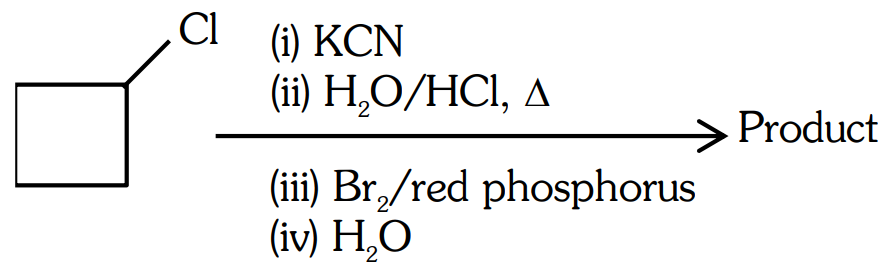 The cyclobutyl chloride reacts with KCN to form the nitrile (substituting Cl with CN), which is hydrolysed with $H_2O/HCl$ on heating to give the carboxylic acid. This acid then undergoes the Hell-Volhard-Zelinsky reaction ($Br_2$/red phosphorus, followed by $H_2O$) to introduce a bromine at the alpha-carbon, giving an alpha-bromo carboxylic acid as the final product.
That is every question in Aldehydes, Ketones and Carboxylic Acids for this filter.
Want a score?
Answers here are not saved. Practise as a test to be marked and see your progress.
Practise as a test