Looking for classes? Ksquare Career Institute, Bengaluru →

Chemistry
Coordination Compounds
104 questions from 38 papers, each with its answer.
- 104 questions
- 38 papers
- 5.91% of Chemistry
Isomerism in Coordination Compounds
-
Number of possible isomers for the complex $[Co(en)_2Cl_2]Cl$ will be: (en = ethylenediamine)$[Co(en)_2Cl_2]^+$ shows cis and trans geometrical isomers.
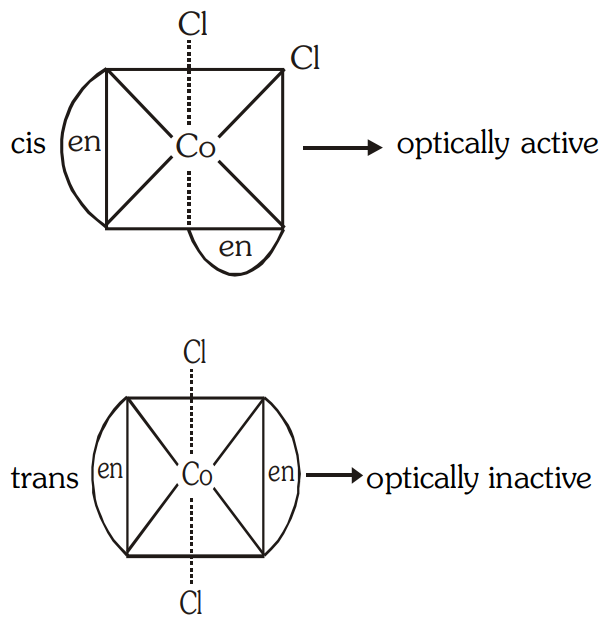
The trans form has a plane of symmetry (optically inactive); the cis form is optically active and exists as a pair of enantiomers.
Total stereoisomers = 2 + 1 = 3
IUPAC nomenclature of complexes
-
The name of complex ion, $[Fe(CN)_6]^{3-}$ is:Six cyanide ligands → hexacyanido; anionic complex of iron → ferrate; oxidation state of Fe = +3.
Name: hexacyanidoferrate(III) ion.
Valence bond theory
-
The hybridization involved in complex $[Ni(CN)_4]^{2-}$ is (At. No. Ni = 28)

Oxidation state of Ni: $x - 4 = -2 \Rightarrow x = +2$; $Ni^{2+}$: $[Ar]3d^84s^0$
$CN^-$ is a strong field ligand, so the two unpaired 3d electrons pair up, leaving one 3d orbital empty.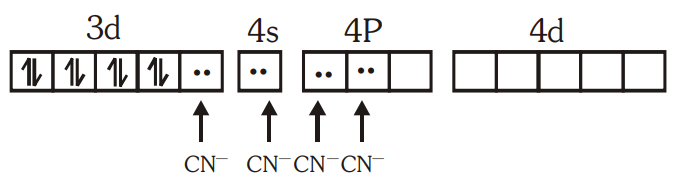
One 3d, one 4s and two 4p orbitals hybridise: $dsp^2$ (square planar).
Coordination number and oxidation state
-
The sum of coordination number and oxidation number of the metal M in the complex $[M(en)_2(C_2O_4)]Cl$ (where en is ethylenediamine) is:Oxidation state: $x + 0 - 2 = +1 \Rightarrow x = +3$
Coordination number: two en (bidentate) + one oxalate (bidentate) = 6
Sum = 3 + 6 = 9
That is every question in Coordination Compounds for this filter.
Want a score?
Answers here are not saved. Practise as a test to be marked and see your progress.
Practise as a test